
You Don’t Have a Campaign Problem. You Have a Governance Problem.
Your campaigns are probably failing. Not because of your budget. Not because of the algorithm. Not because “the market is tough right now.” But because your campaign is run like a side project, owned by nobody, shaped by everyone, and governed by… vibes.
You can call it “integrated.” You can add more channels, more tools, more dashboards, more stand-ups. You can even hire more people. But if your campaigns are designed in silos, executed in isolation, and nobody is actually responsible for the whole system, you are not running campaigns. You are just producing marketing noise at scale.
Whether you are the heroic 360-degree marketer doing strategy in the morning, content at noon, ads in the afternoon, and reporting at night, or a company with 50 people in marketing and an org chart that looks like a modern art installation, the outcome is often the same. Fragmented messages. Disconnected execution. Great individual efforts. Mediocre collective impact.
Let’s be brutally honest about why your campaigns don’t work. What really happens when Product Marketing is not involved. When Marketing Ops is called in too late. When content is treated like a production factory. When “campaigns” are something you run in your corner instead of a system the whole team commits to. And why most campaign failures have nothing to do with creativity or channels, and everything to do with governance.
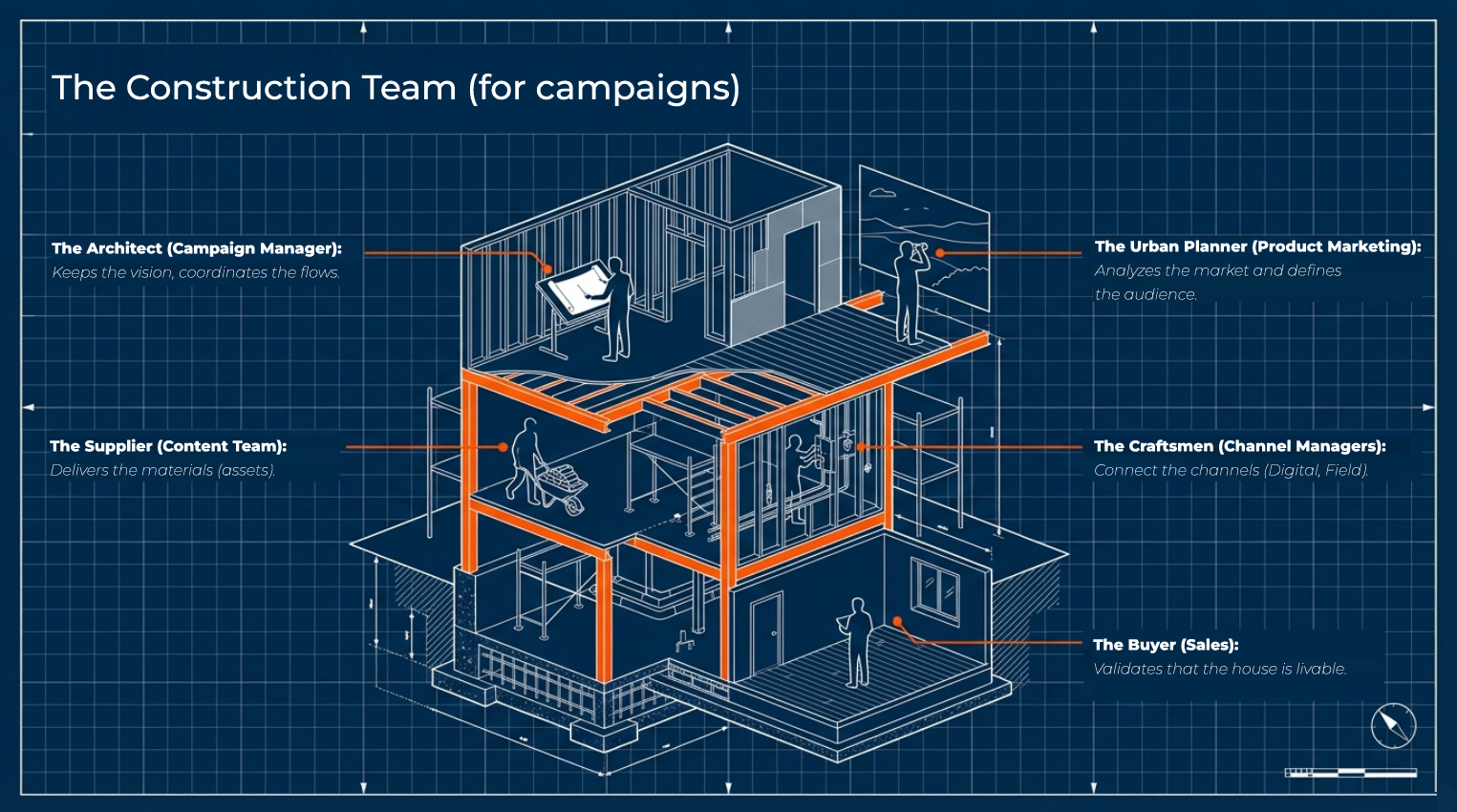
Why Your Campaigns Don’t Work (And Why It’s Rarely a Channel Problem)
When campaigns underperform, the diagnosis usually focuses on executional details. The targeting could have been better. The creatives were not strong enough. The channels were poorly chosen. The budget was insufficient. While all of these elements matter, they are rarely the primary cause of failure.
The more common root cause is structural. Campaigns are often designed as a series of disconnected tasks, owned by different roles, executed by different teams, and evaluated with different success criteria. Everyone does their part, but no one is accountable for the coherence of the whole.
This leads to a pattern that is easy to recognize in most organizations, regardless of size.
- Messages are defined without a shared narrative backbone.
- Content is produced without a clear role in a broader customer journey.
- Channels are activated because they are available, not because they are strategically coherent.
- Measurement is added after the fact, mainly to justify what has already been launched.
From the inside, this often feels like progress. Activity is high, calendars are full, deliverables are shipped. From the outside, the customer experience is fragmented. Each touchpoint may be decent on its own, but together they fail to form a meaningful progression.
This fragmentation becomes even more visible when specific roles are missing from the campaign design process.
When Product Marketing Is Not Involved
Without Product Marketing, campaigns tend to rely on generic messaging and surface-level value propositions. The campaign may be well executed from a channel perspective, but the underlying narrative lacks sharpness and differentiation.
The consequences are usually visible across touchpoints. Paid media emphasizes one angle, content focuses on another, and sales conversations introduce yet another framing of the same offer. Instead of reinforcing one another, channels compete for attention with slightly different stories. What is lost is not visibility, but coherence.
When Marketing Operations Is Brought in Too Late
When Marketing Operations is not involved early in campaign design, orchestration and measurement are treated as technical details rather than structural components of the campaign itself. Journeys look coherent on slides but break down in execution. Automation flows do not reflect the intended progression. Reporting focuses on what can be measured easily rather than what should be measured meaningfully.
In this setup, optimization becomes reactive. Decisions are made based on partial or delayed data, and performance analysis is reduced to post-hoc justification rather than a real feedback loop.
When Content Is Treated as Pure Execution
When content teams are involved only to produce assets, campaigns tend to accumulate materials without a clear logic of progression. Assets are created, but their specific role in the campaign journey is rarely defined. The same content is reused across multiple channels with minimal adaptation, not because it is strategically optimal, but because it is operationally convenient.
The result is not a lack of content, but a lack of narrative structure. Content exists, but it does not compound.
When Campaigns Are Run in Isolation
Whether in small teams or large organizations, campaigns are often run “in a corner.” A solo marketer does everything end-to-end. A demand generation team runs initiatives without close alignment with Product Marketing. Regional teams launch local campaigns disconnected from the broader narrative. Each initiative may be justified locally, but the cumulative effect is a fragmented brand experience.
The problem in all these cases is not competence. It is coordination. Campaigns fail less because people are bad at their jobs, and more because no one is responsible for how all those jobs fit together into a coherent system.
Governance: The Missing Layer Between Strategy and Execution
At this point, the pattern should be clear. Campaigns do not fail because people lack ideas, skills, or motivation. They fail because there is no clear operating model that defines how those ideas, skills, and efforts are supposed to work together.
Most marketing teams operate with a surprisingly vague understanding of how campaigns are governed.
There is often a campaign owner in name, but not in authority. There are multiple contributors, but no clear rules for decision-making. There are processes, but they focus on production milestones rather than on orchestration and coherence. As a result, campaigns become a negotiation space between functions, priorities, and individual agendas.
This is what governance failure looks like in practice:
- No one owns the end-to-end customer journey of the campaign.
- Strategic decisions are made in meetings, but tactical decisions are made in silos.
- Trade-offs between channels, messages, and assets are resolved by convenience or hierarchy rather than by customer logic.
- Success is evaluated through local KPIs, not through the performance of the campaign as a whole.
In such an environment, “integration” becomes an aspiration rather than an operating principle. Teams may agree on the importance of coherence, but the system they work in actively produces fragmentation.
Governance Is Not Bureaucracy
One of the reasons governance is so often avoided is that it is immediately associated with bureaucracy. More meetings, more documents, more validation layers. This is a misunderstanding of the problem.
Good governance does not slow campaigns down. It reduces friction by clarifying how decisions are made, who arbitrates trade-offs, and how different contributions are expected to fit into a coherent whole. The absence of governance does not create speed. It creates rework.
When governance is weak or nonexistent, teams spend more time aligning after the fact. Messaging has to be rewritten because it does not match the positioning. Journeys have to be adjusted because the automation logic does not reflect the intended experience. Content has to be repurposed because it was produced without a clear role in mind. What is perceived as agility is often just the accumulation of avoidable corrections.
Governance at Any Scale: Solo Marketer or 50-Person Team
The governance problem does not only exist in large organizations. It simply takes different forms depending on scale.
For the solo or small-team marketer, governance tends to collapse into personal bandwidth and implicit decision-making. One person acts as strategist, product marketer, channel manager, and campaign owner at the same time. External freelancers or agencies are brought in for execution, but without a shared system that defines how their outputs connect to one another. The result is often a campaign that is consistent with one person’s mental model, but difficult to scale, adapt, or replicate.
For larger organizations, governance issues emerge as coordination problems. Roles are clearly defined on paper, but the interfaces between them are not. Product Marketing defines messages. Content produces assets. Demand Generation activates channels. Marketing Operations manages the stack. Each function is competent within its own perimeter, yet the campaign experience that reaches the customer feels disjointed. The more specialized the organization becomes, the more intentional governance has to be. Otherwise, specialization simply amplifies fragmentation.
In both cases, the root problem is the same: there is no explicit system that defines how a campaign moves from strategic intent to coordinated execution.
What Effective Campaign Governance Actually Looks Like
If governance is the missing layer, the next logical question is simple: what does “good governance” look like in the context of marketing campaigns?
Not in theory. In practice.
Effective campaign governance is not about adding process for the sake of process. It is about making explicit what is usually left implicit: who owns the campaign as a system, how strategic decisions are translated into coordinated execution, and how trade-offs are resolved when priorities collide.
At a minimum, functional governance answers three basic questions.
First, who is accountable for the campaign end-to-end?
Not for one channel. Not for one asset. Not for one metric. For the overall logic of the campaign, from narrative to orchestration to performance. When this accountability is unclear, campaigns become a shared responsibility in the abstract and nobody’s responsibility in reality.
Second, how are decisions made across functions?
Most teams assume that alignment will “just happen” through meetings. In practice, alignment without decision rights quickly turns into negotiation. Governance requires explicit rules: who defines the core narrative, who arbitrates conflicts between channel priorities, who can veto incoherent executions, and how exceptions are handled when constraints appear.
Third, how is coherence enforced across the campaign lifecycle?
Campaign coherence is not a one-off design problem. It has to be maintained as the campaign evolves. New assets are added, channels are optimized, messages are adapted, and performance data introduces pressure to pivot. Without governance, these local optimizations slowly erode the original logic of the campaign until what is running in the market barely resembles what was initially designed.
Roles Matter More Than Job Titles
One of the most common mistakes in campaign governance is to confuse roles with job titles. What matters is not whether your organization has a formal “Campaign Manager” role on the org chart. What matters is whether the functions that role represents are actually covered.
Every campaign requires, at a minimum, the following responsibilities to be clearly owned:
- Narrative ownership: defining and protecting the core story of the campaign.
- Journey design: structuring how the audience moves from awareness to action.
- Orchestration: sequencing assets and channels so that they reinforce one another instead of competing for attention.
- Enablement and infrastructure: ensuring that the systems, data, and automation can support the intended experience.
- Performance management: monitoring outcomes and feeding learnings back into the campaign logic.
In small teams, several of these responsibilities may be carried by the same person. In larger organizations, they may be distributed across multiple specialized roles. In both cases, the critical factor is not who does what, but whether these responsibilities are explicitly assigned and coordinated.
Governance Is a Design Choice, Not an Organizational Accident
In many organizations, governance emerges accidentally. Processes are built reactively in response to past failures. Approval layers are added after something goes wrong. Coordination rituals appear when friction becomes unbearable. Over time, this produces a patchwork of rules that are poorly aligned with how campaigns actually need to operate.
Effective governance, by contrast, is designed intentionally. It starts from the requirements of an integrated campaign and works backward to define how teams should collaborate, how information should flow, and how decisions should be structured. This design effort is rarely visible from the outside, but it is one of the strongest predictors of whether campaigns will compound in effectiveness over time or remain a series of isolated attempts.
Without this design, organizations tend to repeat the same pattern: every new campaign is treated as a fresh project, requiring rediscovery of basic coordination mechanisms. The cost is not only inefficiency. It is strategic inconsistency.
Who Should Be Involved (And What Happens When They Aren’t)
Campaign governance is meaningless without the right people in the room. It doesn’t matter how clever your strategy is or how beautiful your assets are: if the right expertise is absent, the campaign will fragment, and results will suffer.
Here are the critical functions every campaign needs—regardless of whether you’re a solo marketer or part of a 50-person marketing team, and what typically happens when they’re missing.
Campaign Manager / Orchestrator
Role: Owns the campaign as a system. Coordinates all functions, ensures alignment, monitors performance, and resolves conflicts.
What happens when no one owns orchestration:
- Decision-making is scattered.
- Trade-offs between priorities are handled ad hoc.
- Campaigns get delayed or diluted by constant rework.
The campaign manager is the conductor. Without one, it’s a cacophony.
Product Marketing (PMM)
Role: Defines the audience, messaging, and positioning. Shapes the story the campaign tells. Ensures that the campaign answers the right questions for the right personas at the right stage.
What happens when PMM is missing:
Campaigns lack a clear narrative.
- Messaging drifts across channels, leaving prospects confused.
- Value propositions are generic or inconsistent.
- The campaign looks like activity, not strategy.
Think of PMM as the campaign’s compass. Without it, everyone is moving, but nobody knows where “north” is.
Marketing Operations (MOPs)
Role: Manages the tech stack, sets up automation, ensures data flows correctly, and enables measurement. Provides the infrastructure that allows campaigns to scale and be optimized.
What happens when MOPs is missing or involved too late:
- Journeys fall apart in execution.
- Tracking is incomplete, delayed, or inconsistent.
- Optimization is reactive, based on partial or misleading data.
- Reports are assembled to justify what happened, not to guide decisions.
MOPs is the plumbing of the campaign. Ignore it, and everything leaks.
Content Team
Role: Produces the assets that carry the campaign’s story—blogs, videos, emails, social posts, whitepapers, you name it. Ensures each asset serves a clear purpose in the journey.
What happens when content is treated like a service desk:
- Assets exist but don’t reinforce each other.
- Messaging is inconsistent or repeated arbitrarily.
- Creative work is wasted or misaligned with the campaign goals.
Content is not just output—it’s the narrative glue. Without alignment, your campaign is like a Lego set missing the instructions.
Channel Managers
Role: Execute campaigns across their respective channels (paid, owned, social, events, partnerships). Translate strategy into tactical activation without breaking the overarching narrative.
What happens when channel managers operate in isolation:
- Different channels tell different stories.
- Campaign reach may be high, but impact is low.
- Performance improvements in one channel conflict with others.
Channels are amplifiers, not independent campaigns. Treat them like separate islands, and you create noise, not results.
Sales / Field Teams (Optional, but Critical)
Role: Provide insights from the market, validate assumptions, and ensure campaigns are actionable in the real world.
What happens when sales is left out:
- Campaigns may look perfect on paper but fail to convert.
- Messaging is misaligned with buyer realities.
- Leads generated are less likely to close.
Sales are the reality check. Ignore them, and your campaign is an echo chamber.
Structuring the Team for Real Campaign Governance
Understanding roles is one thing. Making them work together is another. The difference between a campaign that feels busy and a campaign that actually delivers measurable results comes down to team structure and governance.
Effective structure is not just about who does what. It’s about how decisions are made, how information flows, and how accountability is enforced. Without this, even the best team is destined to produce fragmented, underperforming campaigns.
The Core Principles of Campaign Governance
Clear Ownership
Every campaign must have a single owner responsible for the end-to-end outcome. Not just a channel, not just content, not just reporting: everything. This person ensures alignment, arbitrates conflicts, and drives the campaign from concept to completion.
Explicit Decision Rights
Governance is meaningless if no one has authority. Decisions about messaging, journey design, asset prioritization, channel sequencing, and budget allocation must have clear owners. Otherwise, you get endless meetings, passive approvals, and last-minute compromises.
Defined Roles and Interfaces
Each contributor (PMM, MOPs, Content, Channel Managers, Sales) must know exactly what they own, what they contribute, and how their work connects to the campaign system. Roles aren’t just job titles; they are functional responsibilities with defined interfaces.
Alignment Rituals, Not Bureaucracy
Governance is often mistaken for endless meetings and reports. It isn’t. Good governance uses structured touchpoints to keep everyone aligned: quick checkpoints, decision reviews, and escalation paths. The goal is less friction, not more paperwork.
Performance Visibility
Campaigns must be monitored at the system level, not just channel-level KPIs. The owner tracks whether the campaign narrative holds across channels, whether assets are reinforcing the journey, and whether outcomes match strategic objectives. Local optimizations are only useful if they improve the whole campaign, not just one silo.
Governance at Any Scale
Small teams / solo marketers:
Governance may live in one person, but responsibilities must be explicit and documented.
External collaborators (freelancers, agencies) should be integrated into this system, not left to operate independently.
The same principles apply: clear ownership, defined decision rights, and performance visibility.
Large teams / multi-role organizations:
Roles are specialized, but their interfaces must be clearly mapped.
PMM, Content, Channel Managers, and MOPs operate within the framework set by the campaign owner.
Governance reduces conflict, ensures coherence, and prevents local optimizations from diluting the narrative.
In both cases, the principle is the same: campaigns only work when governance is intentional, visible, and enforced.
How to Stop Campaigns from Falling Apart
If you’ve read this far, the takeaway is clear: campaigns fail not because of creativity, channels, or tools—they fail because governance is weak, roles are unclear, and accountability is missing.
The challenge is that knowing this isn’t enough. You need a practical system to make governance real, to map responsibilities, to align teams, and to ensure that every asset, message, and channel contributes to the same story.
This is exactly what the RIO Integrated Campaign Framework provides. It doesn’t replace your team or your creativity. It doesn’t tell you which channels to buy or what content to create. What it does do is codify the operating principles that turn fragmented efforts into coherent, measurable campaigns.
It defines clear ownership for the campaign as a system.
It specifies roles and responsibilities for every contributor: PMM, MOPs, Content, Channel Managers, Campaign Owners, and Sales.
It establishes decision rights, alignment rituals, and escalation paths so nothing falls through the cracks.
It ensures that every touchpoint, asset, and channel is part of a coherent narrative journey.
It builds in performance visibility so you can measure impact at the system level, not just per channel.
Whether you’re a one-person marketing team trying to scale, or a global organization with dozens of specialists, the RIO framework provides a blueprint to turn chaos into coordination. It’s not a template for content or campaigns; it’s a template for how campaigns should be run.
The campaigns you’ve launched in silos, the content you’ve repurposed without purpose, the channels you’ve activated without alignment: they all start to work together when governance is intentional, clear, and enforced. That’s the difference between activity and results, between noise and impact.
FAQ
- What is campaign governance in marketing?
-
Campaign governance is the system of ownership, decision rights, accountability, and coordination that ensures a campaign works as a coherent whole rather than a set of disconnected tasks.
- Why do most marketing campaigns fail?
-
Most campaigns fail not because of channels or creativity but because governance is weak, responsibilities are unclear, and there is no single owner accountable for the end‑to‑end campaign experience.
- Who should own a marketing campaign?
-
The campaign should have a dedicated Campaign Manager/Orchestrator who is accountable for alignment, decision arbitration, and campaign outcomes across all functions.
- What role does Product Marketing play in campaign success?
-
Product Marketing defines the audience, messaging, and narrative. Without it, campaigns lack coherence and differentiation across channels.
- Is Marketing Operations important in campaign governance?
-
Yes. Marketing Operations ensures data, automation, tracking, and measurement are accurate and scalable. If Marketing Operations is missing or involved too late, execution breaks down and optimization becomes guesswork.
- How should content teams be involved in campaigns?
-
Content must be aligned to the journey and the narrative, not treated as a service desk. Each asset needs a specific purpose in the campaign rather than being produced in isolation.
- Do small marketing teams need campaign governance?
-
Yes. Even solo or small teams need explicit ownership, defined decision rules, and alignment practices. Without this, external freelancers or consultants operate in silos and the campaign fragments.
- What happens when sales isn’t involved in campaign planning?
-
Excluding sales often results in campaigns that look good on paper but fail to convert because messaging and priorities aren’t grounded in real buyer interactions and frontline insights.
Last update: 2026-06-27 Tags: integrated campaign



 Entrepreneur, CMO international et Professionnel Certifié en Expérience Client (CCXP), j'ai passé ces 16 dernières années à piloter la croissance et la stratégie marketing d'entreprises en Europe et en Asie.
Tout au long de ma carrière, j'ai dirigé des équipes mondiales avec un focus sur le branding et la génération de demande, tout en fondant myfairtool, en publiant deux ouvrages de référence, en animant des podcasts marketing et en développant le RIO Integrated Marketing Campaign Framework.
Sur ce blog, je partage mes méthodes, mes connaissances et mon expérience. N'hésitez pas à me contacter si vous souhaitez mon expertise sur des projets spécifiques.
Julien Rio.














 Français
 English