The Problem Modern Marketing Forgot to Solve
- The Rise (and Struggle) of Integrated Marketing Campaigns
- What Integrated Marketing Campaigns Really Mean
- Why This Approach Changes Everything
- What are the benefits of an integrated approach?
- Why the RIO Integrated Campaign Framework Exists
Marketing has always been a vast territory. Decades ago, it already required balancing messaging, positioning, sales alignment, creativity, and execution. Year after year, new channels, technologies, customer expectations, and methodologies have transformed this once-broad landscape into a true labyrinth.
Today, marketing covers an endless list of activities: market positioning, messaging, content creation, sales-ready assets, digital channels, social media, paid ads, display, visual campaigns, emailing in all its forms, events of every size (hospitality gatherings, roundtables, virtual events, conferences, trade shows, flagship experiences), direct mail, lead generation, branding, channel marketing, partner enablement, web management, analytics, and far more than any single list could capture.
Because everything evolves fast, most marketers are forced to split attention across dozens of touchpoints, platforms, and priorities. That is how silos appear.
A digital campaign here, a direct mailing there, an Instagram activation on the side, a webinar floating somewhere in the middle: each activity may be meaningful on its own, but disconnected, they form a fragmented system where messages shift subtly and lose impact, visuals differ and confuse the audience, teams work in parallel instead of together, data is scattered and difficult to track, follow-up becomes inconsistent, and customer journeys feel disjointed.
This fragmentation makes the marketer’s job harder and the customer's experience weaker.
The Rise (and Struggle) of Integrated Marketing Campaigns
To fight fragmentation, marketers often talk about integrated campaigns. On paper, the idea is elegant: align channels, synchronize tactics, unify the experience.
In reality, integrated campaigns are often difficult to implement. The theory is inspiring, but the execution can quickly fall apart because teams don’t share a single campaign architecture, assets are created independently, channels aren’t sequenced, follow-ups differ depending on ownership, leads get lost between platforms, and message coherence fades over time.
That gap between theory and execution is precisely why RIO Integrated Marketing Campaign Framework exists in practical form: to bridge the distance between inspiring ideas and repeatable, measurable campaigns.
What Integrated Marketing Campaigns Really Mean
An integrated campaign is not “multiple activities happening at the same time.” It is a deliberate, orchestrated motion where all channels and tactics feed one another in a logical flow designed around one message, one target, one purpose.
Example, simplified: you’re selling products A, B, C. Your goal is new customer acquisition. Your target is a defined buyer persona in a specific industry.
The silo version
- February: a roundtable for that buyer persona
- January to March: a radio ad
- June: a webinar
- March to September: LinkedIn paid ads promoting a white paper
Each piece lives on its own timeline, with its own message, assets, lead flow, and owner. They may help, but they don’t reinforce one another and the global view of the effort is a challenge.
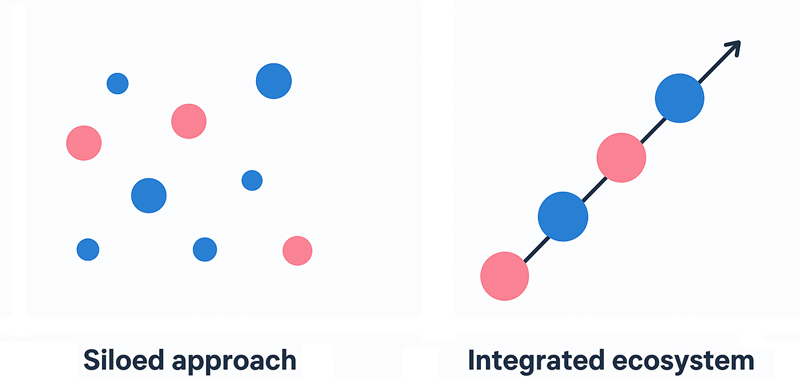
The integrated version
- Activity A launches and generates engagement.
- Anyone who interacts with A flows automatically into Activity B for nurturing.
- Those engaged in B receive an invitation to Activity C (webinar or roundtable).
Messaging, visuals, follow-up, and tracking are unified. Each activity reinforces the next one in a seamless rhythm. This is not theory: it is designing your campaign as a single ecosystem, not twenty small independent actions.
Why This Approach Changes Everything
From the customer's perspective:
- Everything feels natural.
- Messages make sense.
- The journey flows with continuity instead of chaos.
From your perspective as a marketer:
- You gain clarity.
- You understand how each step influences the next.
- Tracking becomes meaningful and decision-making easier.
- Instead of juggling 50 isolated activities, you manage a few coherent campaigns with a clear budget, audience, architecture, flow, and follow-up strategy.
From a team perspective:
- People stop working in their corners and start collaborating around one shared framework.
- Everyone knows how their part contributes to the bigger picture.
What are the benefits of an integrated approach?
The RIO Framework transforms fragmented marketing efforts into a cohesive, high-performance system by delivering superior efficiency, clear strategic alignment, and a better customer experience.
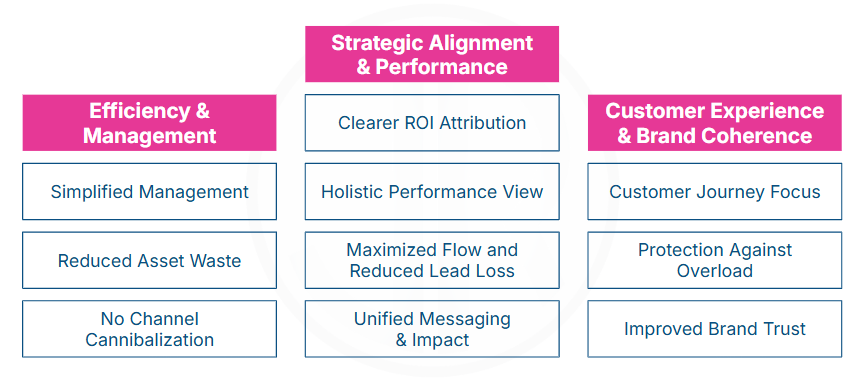
Efficiency & Management
These benefits focus on how the framework streamlines your work, saves resources, and improves internal processes.
- Easier Management of Complex Campaigns: The RIO Framework replaces multiple independent activities with a single, coherent system, making the overall campaign easier to plan, execute, and monitor.
- Reduced Asset Waste: By forcing a focus on a unified goal, the framework ensures you create and use only the assets that matter, eliminating the effort and cost associated with generating unused marketing materials.
- Reduced Activity Cannibalization: The integrated approach minimizes the risk of different teams or channels competing against each other for the same audience or conversion, ensuring all efforts are mutually reinforcing.
Strategic Alignment & Performance
This category highlights how the framework drives better results and provides clearer insights for decision-making.
- Clearer ROI Attribution: With all activities linked to a single goal and tracked within a coherent system, the framework makes it easier to accurately attribute revenue and demonstrate the overall Return on Investment (ROI) of the entire integrated campaign.
- Holistic Performance View: It provides a bigger picture of how all activities perform together, allowing for more meaningful tracking and easier decision-making based on integrated data, rather than isolated channel metrics.
- Maximized Flow and Reduced Lead Loss: By explicitly thinking in terms of flow, the framework forces the optimization of transitions between steps, significantly reducing friction points where potential leads might drop off (leaky funnel).
- Unified Messaging & Increased Impact: Centralizing the campaign strategy allows for a single, consistent brand message across all channels and touchpoints, which increases recognition, trust, and overall campaign impact.
Customer Experience & Brand Coherence
These benefits emphasize the customer-centric nature of the RIO approach.
- Customer Journey Focus: The framework allows for thinking in terms of the complete customer journey, where each marketing activity seamlessly feeds into the next, creating a natural and high-performing progression toward conversion.
- Protection Against Audience Overload: By providing a clear, integrated plan, the framework inherently reduces the risk of spamming or over-saturating the audience with repetitive or poorly timed communications.
- Improved Brand Trust: A consistent, unified, and non-spammy experience fosters greater customer trust and a more positive perception of the brand.
Why the RIO Integrated Marketing Campaign Framework Exists
The RIO Integrated Marketing Campaign Framework is designed to turn the idea of integrated campaigns into something concrete, structured, and applicable for any marketing team. It guides you from the very beginning of a campaign, long before execution, all the way to activation and ongoing optimization.
This playbook explains how the framework works, why it is essential for modern marketing, how to deploy it across your organization, how to use each phase (Rally, Integrate, Orchestrate), how to connect all your activities into one unified system, and how to download and apply all templates immediately in your own campaigns.
Origin of the RIO Integrated Marketing Campaign Framework
Before diving into the mechanics of the RIO Integrated Campaign Framework, it’s worth explaining where it comes from and why it exists.
I’m Julien Rio. Over the years I’ve worked in international marketing across industries, regions, and business models. In every context, the same problem emerged: teams working hard on activities that never fully connected. Roundtables here, paid ads there, webinars floating in the void, white papers left unpromoted. Great work, scattered results.
I realized I needed more than good intentions. I needed a framework: practical, actionable, and grounded in the real world, not just theory. Step by step, project by project, iteration by iteration, the flow emerged. Campaigns began to look like systems instead of isolated tasks. Visibility improved. Collaboration increased. Consistency became achievable. This is how the RIO Integrated Campaign Framework was born: from necessity, not ideology.
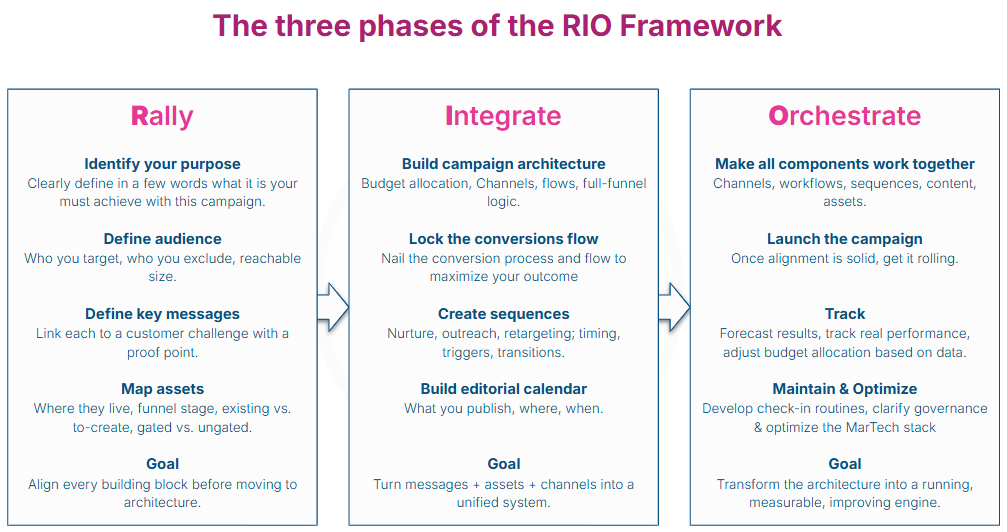
The framework rests on three phases:
Rally
Where it all begins. Gather people, assets, messages, and resources into one coherent universe. No more “oops, we forgot the landing page.”
Integrate
Where strategy becomes a system. Connect messages to personas, assets to channels, activities to each other. Nothing left behind, no dead ends in the customer journey.
Orchestrate
Where campaigns come alive. Activities are sequenced, launched, tracked, and measured. Independent tasks transform into a single, living, measurable campaign.
The goal of RIO Integrated Campaign Framework is simple: make integrated campaigns actually doable (practical, real, and immediately applicable) while reducing the creation of assets that never get used. It aligns marketing operations with a human-centric, ROI-driven philosophy so every action contributes to both business goals and the customer experience.
What truly sets the RIO Integrated Campaign Framework apart is that it is strictly audience-based. Most traditional models are built around a product launch, a specific geography, a business goal like "upsell," or a seasonal theme. This framework flips that logic. It operates on a single, unwavering principle: one campaign = one audience. An audience is defined by a group of people who care about the same things and react to the same triggers and messages. Because every person within this audience will be delivered the same content, it is essential that they share the same perspective and pain points. This approach ensures your message is always on-point and allows you to rotate products, announcements, or topics seamlessly within the same architecture without ever having to rebuild from scratch. As you dive in, keep this at the core of your strategy: every campaign must serve one specific, well-defined audience.
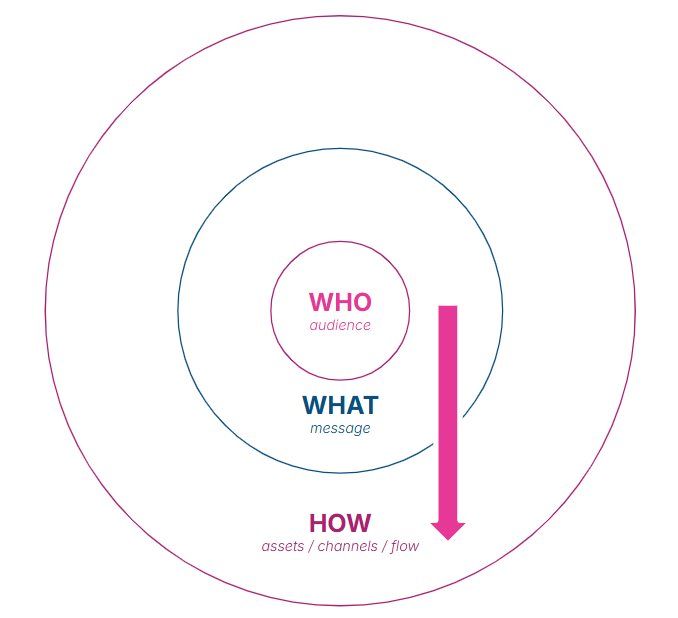
Every campaign rests on three key elements: who, what, and how.
- Who is your audience: the people you’re addressing.
- What is your message: what you need them to understand or feel.
- How covers the channels, assets, and methods you use to reach and connect with them.
When building your campaign, always start with the who, since this is the one element that remains stable over time.
Next, define the what: your message. It may evolve slightly, but it should stay mostly consistent.
Finally, determine the how: the ways you engage your audience and deliver your content. This part can be regularly refreshed and optimized.
The RIO Integrated Framework follows this very logic: starting with who and progressing toward how.
By the end of this playbook, you’ll not only understand RIO Integrated Campaign Framework, you’ll be able to implement it immediately using the downloadable templates and tools to create campaigns that truly work. What I’m sharing is the result of many years of learning, experimenting, and refining a methodology that is robust and delivers the true value of integrated marketing.
 |
Instructions for B2C: The RIO Integrated Marketing Campaign Framework is a robust, extensively tested architecture for complex marketing operations in B2B environments with long sales cycles and multiple stakeholders. Its core logic of Rally, Integrate, and Orchestrate can be adapted to B2C, though it was not originally designed for it. Throughout this page, notes marked with a B2C icon show how to adjust specific elements for consumer behavior, speed, and volume. Experienced practitioners can apply the framework in B2C by translating B2B concepts like personas, funnels, and KPIs into consumer segments, lifecycle strategies, and B2C performance metrics. Teams seeking a fully prescriptive B2C approach will need to supplement these guidelines with their own expertise. |
 |
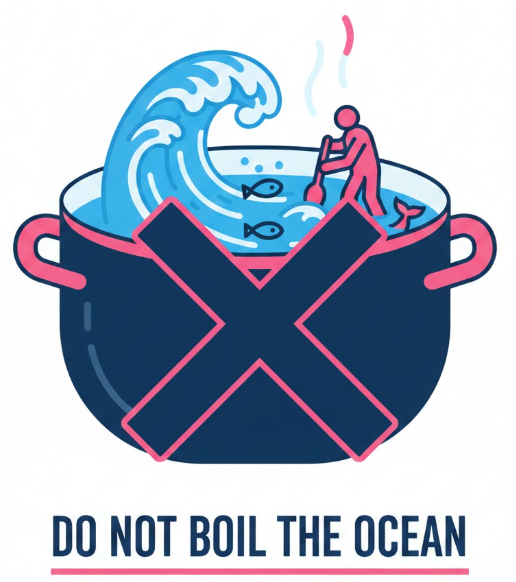
Important Note on Implementation: The RIO Framework’s power comes from its rigor, but its adoption must be gradual. Do not attempt to boil the ocean. Your first RIO-driven campaign should be designed to be small and manageable. Focus on mastering the process (aligning assets, defining clear sequences) before you attempt complex, multi-channel initiatives. Complexity should be earned through early, successful iterations. |

Campaign Team: The Backbone of an Integrated Campaign
- The Heart of the Team: The Campaign Manager
- Key Teams Surrounding the Campaign Manager
- Why it is similar to building a house
- Why This Step is Non-Negotiable
Before diving into the Rally phase and starting to define goals, audience, messaging, and assets, it’s critical to establish the right team. Integrated campaigns aren’t a one-person job. By definition, an integrated campaign requires alignment across multiple functions: every activity must connect, every message must reinforce the others, and every channel must flow in harmony. To achieve that, you need a clearly structured team where everyone knows their role and responsibilities.
Without this, even the best-laid plans risk falling apart in execution: assets may go unused, messages may contradict each other, channels may work in isolation, and tracking may be impossible. This step is therefore absolutely foundational.
The Heart of the Team: The Campaign Manager
At the center of the team is the Campaign Manager. Think of this role as the architect of the campaign, responsible for the end-to-end orchestration of every activity.
The Campaign Manager:
- Keeps the big picture in mind, ensuring every action aligns with campaign goals.
- Coordinates with all other teams to make sure messaging, assets, and channels flow seamlessly.
- Tracks progress, performance, and dependencies, identifying gaps or bottlenecks before they become problems.
But importantly, the Campaign Manager doesn’t work in isolation. Integrated campaigns are complex and no one person has all the answers. Every team member should participate in planning and design discussions, sharing expertise and influencing the campaign’s architecture. The Campaign Manager’s job is to put all the pieces of the puzzle together, and PMM, content, channel managers, MOPs, and sales provide the insights that make the blueprint practical and effective.
Key Teams Surrounding the Campaign Manager
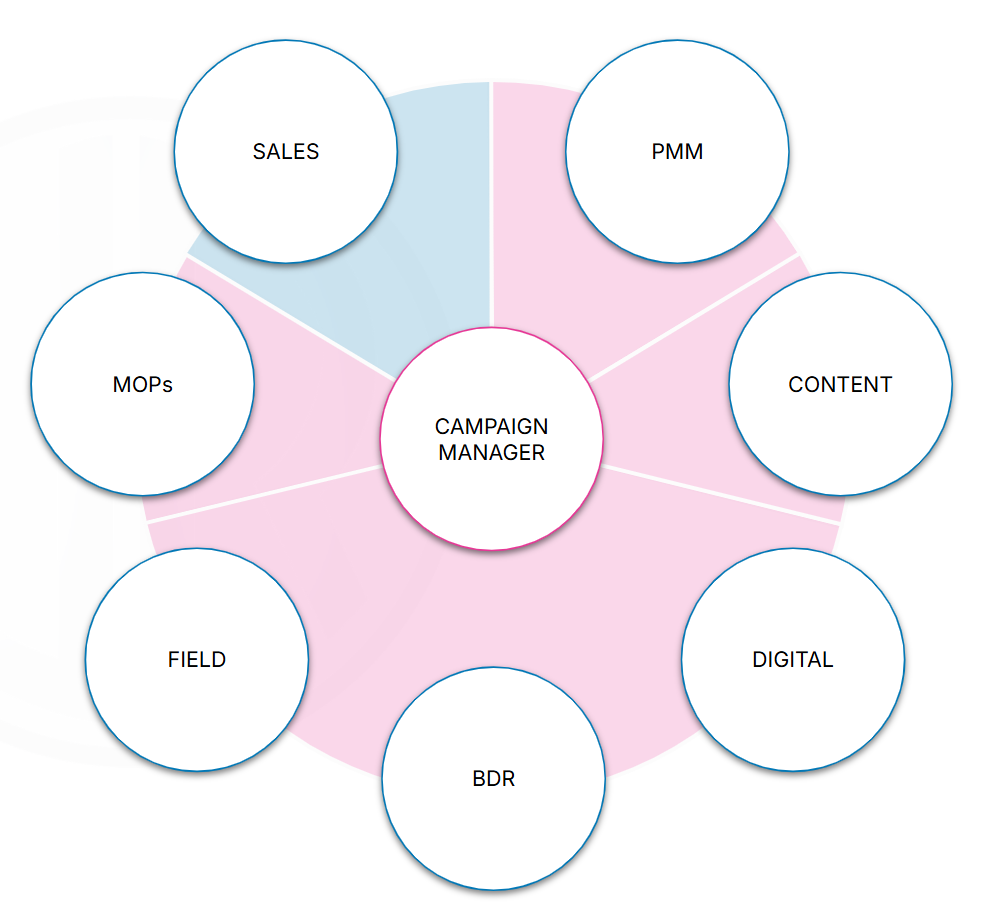
An integrated campaign relies on multiple supporting teams, each with specialized responsibilities. These teams form the core engine of your campaign:
1. Product Marketing (PMM)
Product marketing guides audience and messaging strategy. They:
- Define the campaign audience and ensure focus on the right segments.
- Refine top messages and key proof points.
- Align campaigns with product positioning and market needs.
Without product marketing, campaigns risk being off-target or sending mixed signals to potential customers.
2. Content Team
The content team creates and optimizes campaign assets:
- Written content: blogs, e-books, guides, email templates.
- Visuals: videos, infographics, presentations.
- Tools: calculators, templates, interactive content.
They ensure every piece of content aligns with the messaging framework and resonates with the target audience.
3. Channel Managers
Channels are the conduits through which your campaign reaches the audience. Channel managers include:
- Digital Team: SEM, social, paid campaigns, display, and online touchpoints.
- BDR/Outbound Team: outbound campaigns, personalized sequences, direct prospecting.
- Field Team: offline channels, events, roundtables, and in-person initiatives.
Each channel manager ensures execution within their domain aligns with the integrated strategy and communicates effectively with other channels.
4. Marketing Operations (MOPs)
MOPs is the technical backbone and performance tracker:
- Implement technical setups (automation, CRM integration, data flows).
- Ensure campaign tracking and analytics are accurate and actionable.
- Generate insights in real time to inform decisions and optimizations.
5. Sales Team
While not formally part of marketing, sales is a critical partner. Their involvement includes:
- Contributing to audience definition and identifying high-value prospects.
- Providing feedback on messaging that resonates in the field.
- Aligning on campaign objectives and expectations for conversion.
- Collaborating on follow-ups, lead handoffs, and conversion tracking.
|
Instructions for B2C: In a B2C context, Sales and Business Development roles are replaced by a cross-functional consumer growth team. Campaign execution relies on four mandatory owners: a Brand and Creative Lead responsible for narrative consistency and emotional impact, a Performance Marketing Lead accountable for paid media efficiency and audience expansion, a CRM and Lifecycle Lead owning retention, repeat purchase and loyalty activation, and an Ecommerce and Customer Experience Lead ensuring frictionless conversion and post-purchase readiness. The Campaign Manager coordinates trade-offs between brand equity, short-term performance and long-term customer value, rather than managing lead handovers. |
Think of it like building a house
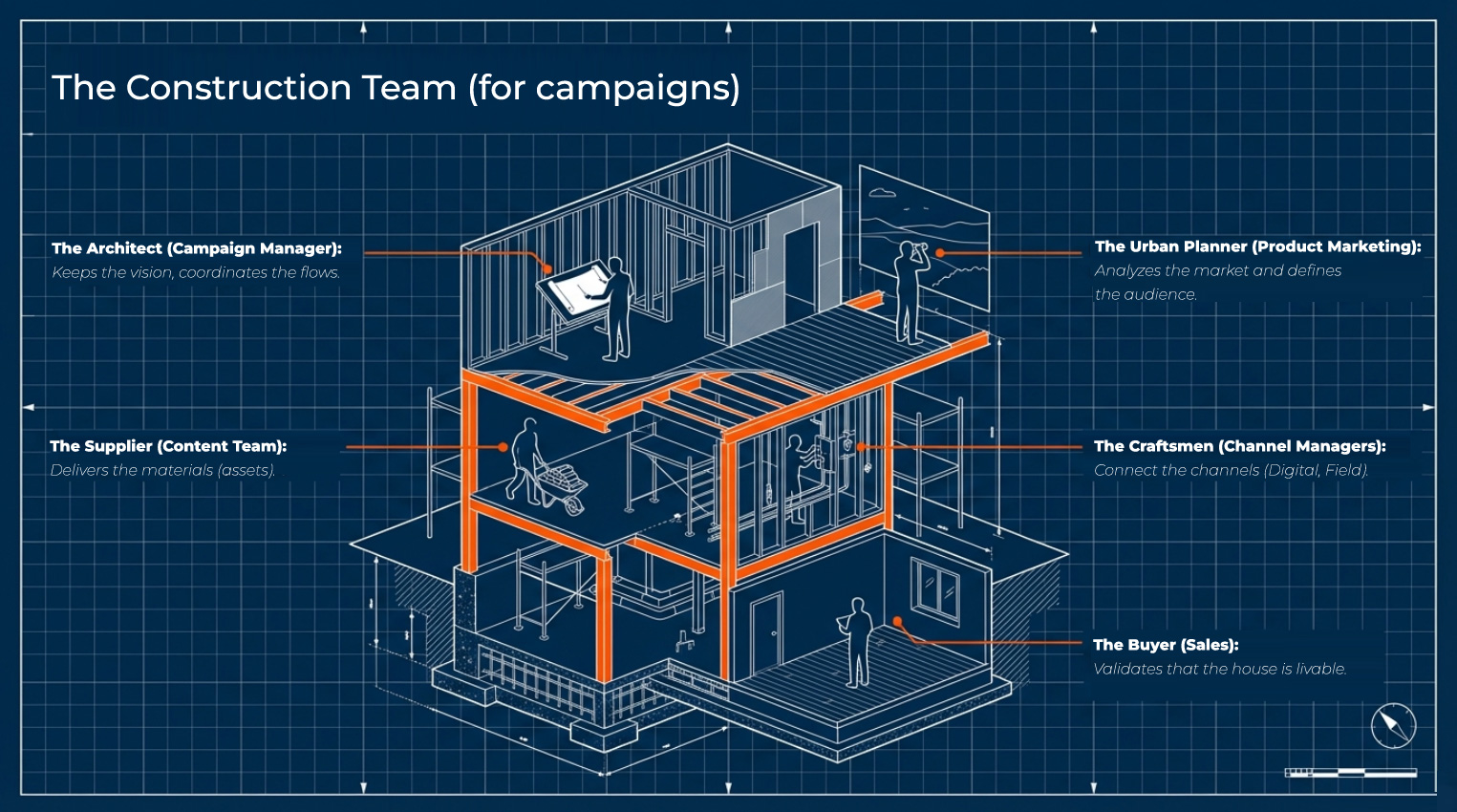
The Campaign Manager is the architect, drawing the blueprint and managing the project.
Product Marketing is the urban expert, analyzing the soil, ensuring alignment with market rules, and advising on structural feasibility.
The Content Team is the materials supplier, providing the right bricks, beams, and tiles, but only once they understand the conditions and purpose of the house.
Channel Managers (digital, field, BDRs) are the plumbers, electricians, and builders translating plans into real construction.
MOPs is the quality assurance team, measuring progress, checking the foundations, and ensuring everything is on spec.
Sales is the ultimate buyer, ensuring the final house actually meets the needs it was intended to satisfy.
Why This Step is Non-Negotiable
Integrated campaigns succeed or fail based on alignment and clarity. By assembling the right team with clearly defined roles and involving each member in planning and campaign design, you:
- Avoid duplicated effort and misaligned messaging.
- Ensure every asset, channel, and activity has a purpose.
- Enable faster decision-making and smoother execution.
- Create a culture of collaboration where everyone understands their contribution to the campaign’s success.
|
Important note on team maturity: The structure described above assumes a mature, fully staffed marketing organization where specialist roles are available in-house. Depending on your specific setup, you may have a smaller or different structure, and some roles may be externalized to agencies or freelancers. The framework is intentionally presented as an ideal team structure; adapt it to your reality. Whether you have a compact team with multi-role contributors or a wide network of external partners, the principles of alignment, ownership, and shared architecture remain the same. |
Rally – Gathering the essential elements that anchor your integrated campaign
- 1. Define Your Goal
- 2. Define Your Audience
- 3. Define Your Messaging
- 4. Rally Your Assets
- 5. Identify Potential Channels
- 6. MarTech Integration and Data Alignment
- Wrapping up Rally
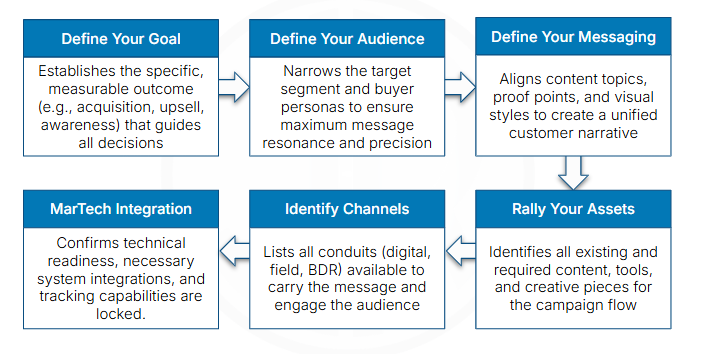
The first phase of the RIO Integrated Campaign Framework is Rally. This phase sets the foundation for everything that follows. Its purpose is simple: gather all the necessary elements (people, assets, messages, audiences, and channels) into a single, coherent view before you start building and executing your campaign.
Rally is about clarity, alignment, and completeness. Before you create a single asset, run a single ad, or plan a single event, you need to define the team's responsibility, the campaign goal, the audience, the messaging, the assets, and the potential channels. Only when these are clear can you move into Integrate.
1. Define Your Goal
The first step is to define your campaign’s purpose. Every integrated campaign is built around a specific, measurable goal. It should never be “just marketing.” Your campaign must have a clearly articulated outcome that guides every decision you make.
Ask: what are you trying to achieve? Common goals include:
- Customer acquisition: generate new revenue and acquire new customers.
- Upsell / cross-sell: expand within existing accounts.
- Brand recognition: build awareness, strengthen perception, educate your audience.
- Customer migration: move customers from end-of-life products to new offerings.
- etc.
 |
Keep the goal concise (one short sentence) so anyone involved can understand the objective at a glance. In the next phase, we will be more specific and list both KPIs to track and targets to hit. |
2. Define Your Audience
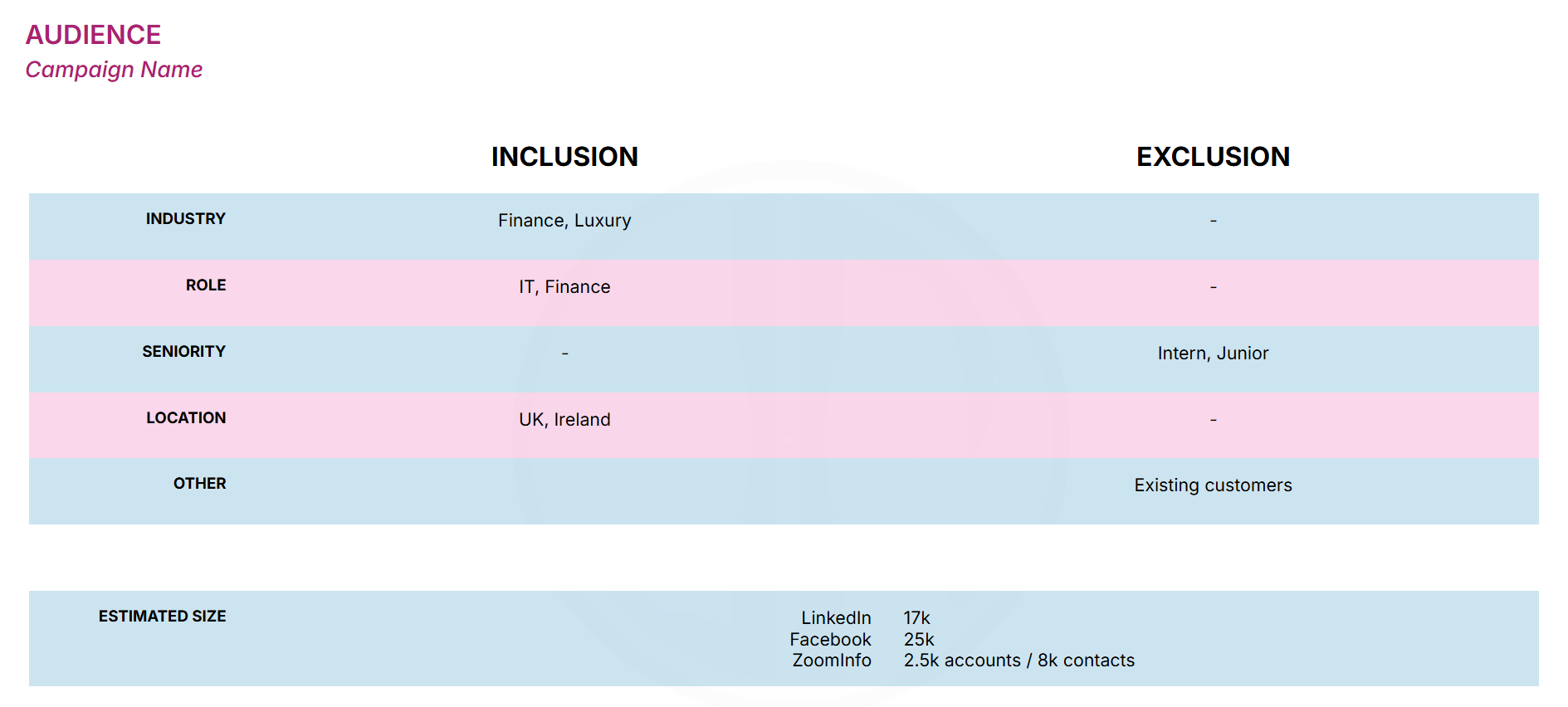
This step is the foundation for everything you build afterward. In this model, one audience = one campaign, so it is critical to get it right from the start. An audience is defined by people who care about the same things and respond to the same triggers. By ensuring everyone in your segment shares the same perspective and pain points, you can deliver a campaign that is perfectly tailored and truly resonates. This also helps you avoid cannibalizing your own efforts or spamming your audience with messages that are too frequent or contradictory.
|
Dealing with multi-persona accounts. What should you do when handling complex deals that involve, for example, a CFO, a CTO, and a CIO? These stakeholders often care about very different things and react to entirely different triggers. The rule is simple: don't think product, think audience. In this scenario, you should create as many campaigns as you have audiences. This ensures each campaign stays laser-focused on the specific messages that resonate with that group. While you can regroup these campaigns under one strategic umbrella for easier reporting and attribution, you must never mix audiences within a single campaign architecture. |
Define your audience
- Define the segment you will target (SMB, mid-market, enterprise).
- List industries to include or exclude.
- Define geographic focus (city, country, region).
- Identify buyer personas (CFOs, CTOs, COOs) and required seniority.
- Customize further as needed: Consider additional factors like behavioral data or specific technologies used, depending on your unique situation.
|
Instructions for B2C: In B2C campaigns, messaging is structured around behavioral and attitudinal segments rather than job-based personas. Segments are defined by purchase frequency, price sensitivity, brand affinity, decision speed and motivational drivers. Messaging frameworks prioritize emotional triggers, identity signals and contextual relevance over functional pain points. Each segment receives a distinct narrative angle aligned with its dominant motivation and stage in the customer lifecycle. |
Refine your target for precision
Narrow the audience so your messages resonate. Avoid overcomplicating by targeting too many personas at once: each persona has its own concerns, its own challenges, and adding too many personas might make the campaign less relevant for any of them.
Test audience size across tools
Check audience size using intended channels:
- LinkedIn / Facebook / Google Ads: reachable audience size.
- Email / CRM databases: segmentation coverage.
- External platforms / vendors: support for criteria.
- Events / roundtables: vendor ability to find matching prospects.
This validates whether your audience is too broad, too narrow, or just right for meaningful results.
3. Define Your Messaging
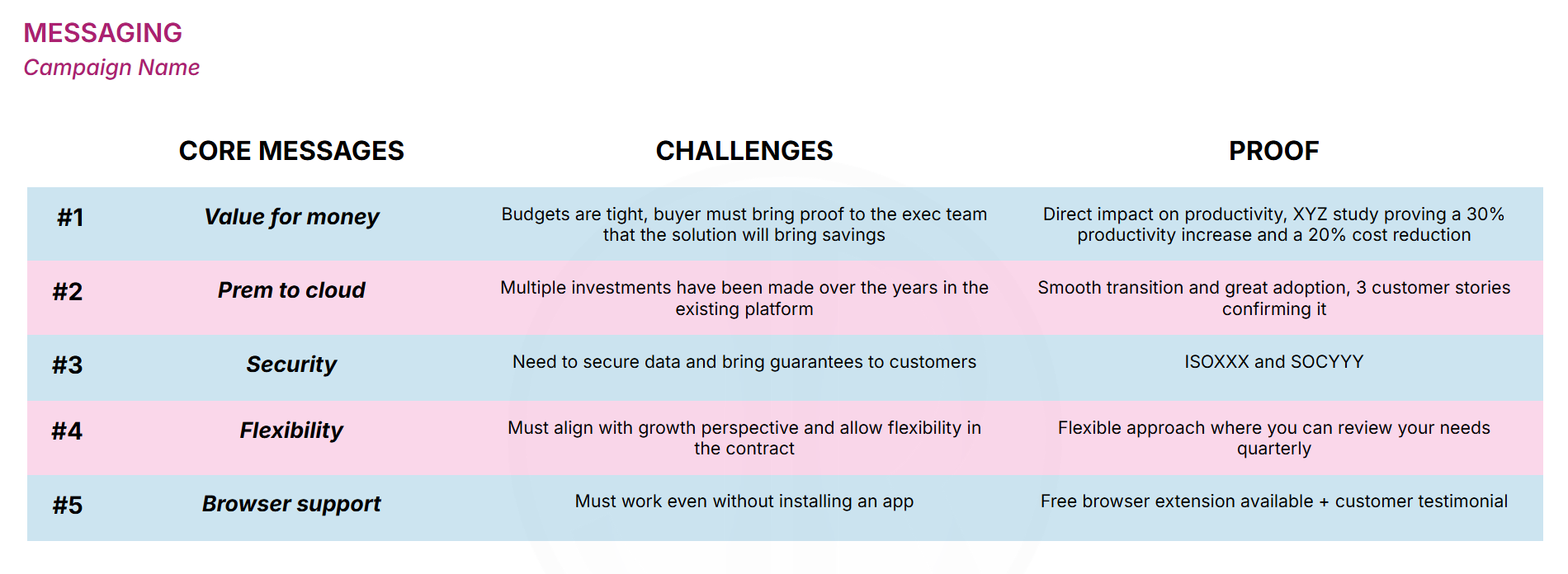
Messaging is the backbone of your campaign: it provides the DNA for every asset, ad, and activity you create. Your audience receives dozens of messages daily; messaging that resonates with specific personas and addresses real challenges drives engagement and conversion.
Why messaging is critical
Consistent messaging ensures every touchpoint (email, ad, webinar, roundtable) reinforces the same core value proposition.
Start with a Messaging House (if available)
If your PMM team is mature, you may already have a messaging house: a document defining top messages per product, regional considerations, and messages per persona.
Example: A CFO, CTO, and COO will not respond to the same message.
- CFO → ROI, budget, cost savings.
- CTO → integration, security, reliability.
- COO → operational efficiency, flexibility.
Select the top messages for your campaign
Pick 3–5 core messages that best resonate with your target and identify the challenge each creates plus the proof you have to solve it. Define the challenge and the proof point for each message: these become the guiding stars for every asset and activity in the campaign.
|
These messages, challenges, and proofs become the holy grail of your campaign. Every ad, email, video, webinar, or social post should tie back to one or more messages. Lock messaging before building assets to ensure consistency and reduce wasted effort. |
4. Rally Your Assets
Once goal, audience, and messaging are clear, gather and organize all assets that will support the campaign. Assets can include white papers, e-books, guides, videos, calculators, templates, email sequences, landing pages, and any material that educates, persuades, or converts.
What counts as an asset?
- White papers, e-books, guides, blog articles
- Videos: demos, customer stories, interviews
- Tools: calculators, templates, interactive content
- Email sequences and scripts
- Landing pages for campaigns
|
Instructions for B2C: B2C campaigns prioritize high-velocity, consumer-centric assets, but asset selection must be explicitly aligned with the customer lifecycle stage targeted by the campaign. Acquisition assets focus on attention, emotion and social proof through short-form video, UGC and creator content. Conversion assets emphasize reassurance and urgency through offers, testimonials and product demonstrations. Retention assets reinforce value and habit through loyalty messaging, education and community storytelling. Assets are not reused indiscriminately across stages; each asset is designed for a specific behavioral outcome. |
How to identify relevant assets
For each potential asset, ask: Does it speak to my audience? Does it reinforce a top message? Could it be adapted with minor changes? If yes, include it.
Leverage the Big Rock Approach to Scale Content
This demand for content can quickly become the biggest bottleneck in the Rally phase.
To solve this content supply problem, the RIO Framework strongly recommends leveraging the Big Rock Content methodology. This approach is simple: instead of creating dozens of isolated assets, you focus your resources on producing one comprehensive, high-value piece of cornerstone content (the "Big Rock"). This single, foundational asset is then systematically atomized (repurposed and sliced) into the many smaller, modular assets (social posts, short videos, retargeting ads, email excerpts) needed for the Integrate phase.
This strategic reuse ensures two things vital to RIO:
- Efficiency: It prevents resource depletion and guarantees you have all the necessary assets before launch.
- Consistency: Every piece of content, regardless of channel, maintains consistent messaging because it originates from a single source of truth.
By using the Big Rock approach, you move the content production step from a scattergun tactic to a scalable, repeatable manufacturing process.
Map assets to the marketing funnel
Organize assets by funnel stage:
- Awareness → content introducing your brand/product
- Consideration → content that educates and differentiates
- Conversion → content that helps customers decide
List out all the existing assets as well as everything that doesn't exist yet but could become useful for the campaign. Make this list as exaustive as possible.
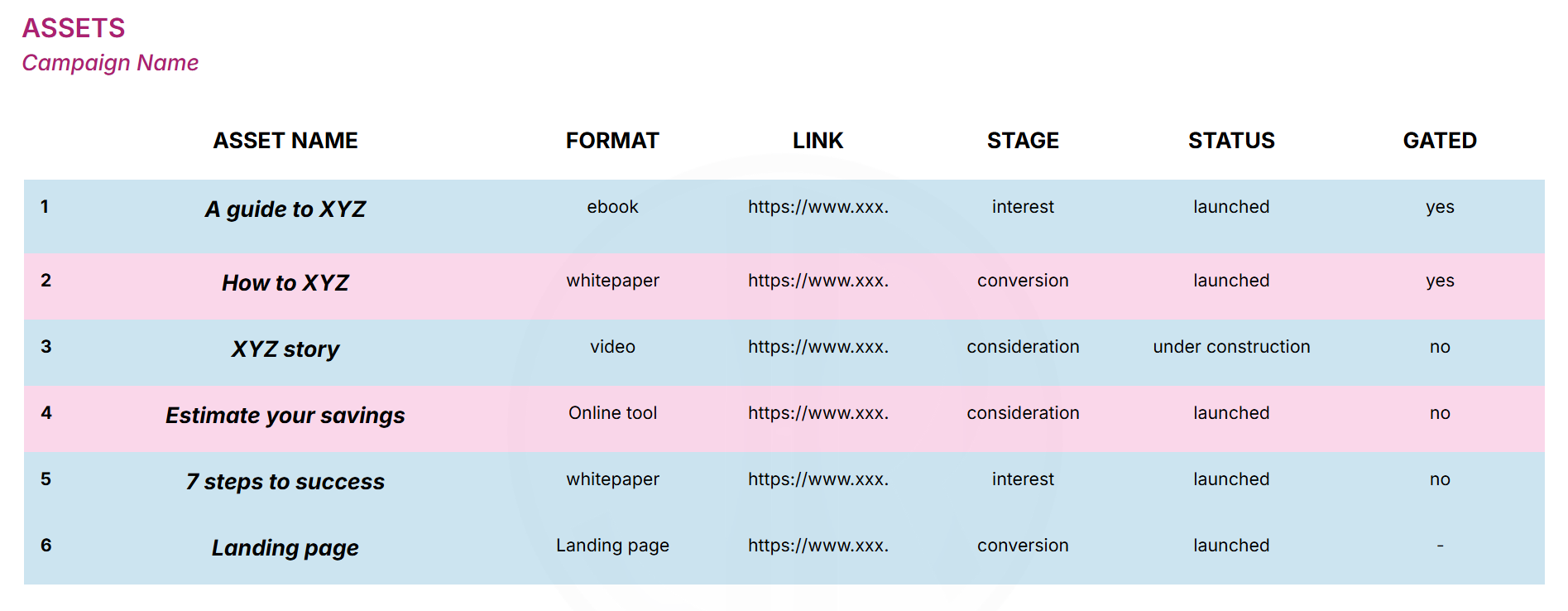
Mapping ensures every stage is covered and prevents creating assets that will remain unused. Include landing pages for digital parts of the campaign: they’re essential for tracking and lead capture.
|
At this stage, we do not build or amend anything. We simply list everything that is and everything that could be. At a later stage we will shorten that list and only build what truly matters. |
5. Identify Potential Channels
List all channels you currently support or could use. At this stage, aim for exhaustiveness, not selection.
What to include
- Digital advertising: SEM, social media, display
- Email and direct mail: newsletters, drip campaigns
- Events: webinars, roundtables, conferences, trade shows
- Nurturing and outbound: BDR teams, phone campaigns
- Content syndication: partner platforms, third-party networks
Listing every channel ensures nothing is forgotten. Channel selection happens in Integrate, once you see how each channel can logically flow in your campaign.
6. MarTech Integration and Data Alignment
A MarTech stack refers to the integrated set of technologies (software and platforms) required to execute your marketing strategy.
While the RIO Framework defines the strategic process and integrated blueprint, the campaign will not function without a robust, interconnected technical infrastructure. This is why you must make sure this aspect of your campaign is clear before moving on to the next phase.
You need a clear overview of these tools because their proper integration is critical for seamless data flow and process automation. However, this list is non-exhaustive and the framework don't suggest one platform over another, as the final list of technologies depends entirely on your specific campaign goals (e.g., lead generation, retention), the channels you plan to leverage and your existing ecosystem.
|
Technology |
Purpose |
Necessity |
Examples |
|---|---|---|---|
| 1. Core Customer Data & Automation | |||
| CRM | The central single source of truth for all contact and account data, sales pipeline tracking, and revenue reporting. | Mandatory | Salesforce, HubSpot CRM, Zoho CRM |
| Marketing Automation | Manages lead nurturing, segmentation, lead scoring, and automated communications. Facilitates the technical handoff to Sales. | Strongly recommended | Marketo, HubSpot Marketing Hub, ActiveCampaign |
| CMS | Manages the website, landing pages, and the digital assets used in the campaign flow. | Mandatory | WordPress, Drupal, Contentful |
| 2. Channel Execution & Management | |||
| Advertising/Channel Platforms | Native tools used to launch, manage, and optimize specific channel campaigns (e.g., paid social, search, display). | Mandatory (based on channel selection) |
Google Ads, LinkedIn Campaign Manager, Meta Ads Manager |
| Outbound/Sequencing Tools | Tools for structuring personalized, multi-step email or social outreach sequences (used by Sales/BDRs). | Recommended (based on channel selection) |
Salesloft, Outreach, Apollo.io |
| 3. Data Intelligence & Enrichment | |||
| Contact/Data Enrichment Tools | Automatically gathers, verifies, and appends missing contact and company data (emails, firmographics) to incoming leads and supports outbound campaigns. | Recommended | ZoomInfo, Cognism, Lusha, Clearbit |
| Intent Data Providers | Identifies companies showing active intent signals (e.g., searching key terms) to prioritize sales and marketing efforts. | Optional | 6sense, Demandbase, Bombora |
| 4. Optimization & Governance | |||
| Analytics & Reporting | Aggregates data from all channels into a common system to measure holistic performance (ROI, attribution) against goals. | Mandatory | Google Analytics, Adobe Analytics, Tableau |
| Sales Enablement Tools | Provides Sales with the right content, training, and context needed for effective post-handover engagement and to enforce internal SLAs. | Optional | Highspot, Seismic, Guru |
Rally Phase Wrap-Up
By now you have a clear goal, a well-defined audience, top messaging with proof points, a comprehensive asset list mapped to funnel stages, and an exhaustive channel list. This foundation prepares you to build a fully integrated campaign in the Integrate phase.
RIO Framework Template Guidance
- "MESSAGING" slide: Add top messages for the campaign.
- "AUDIENCE" slide: Define audience and estimate sizes across channels.
- "ASSETS" slide: Map existing assets and identify gaps.
- "ARCHITECTURE" slide: The campaign architecture page: the heart of Integrate.
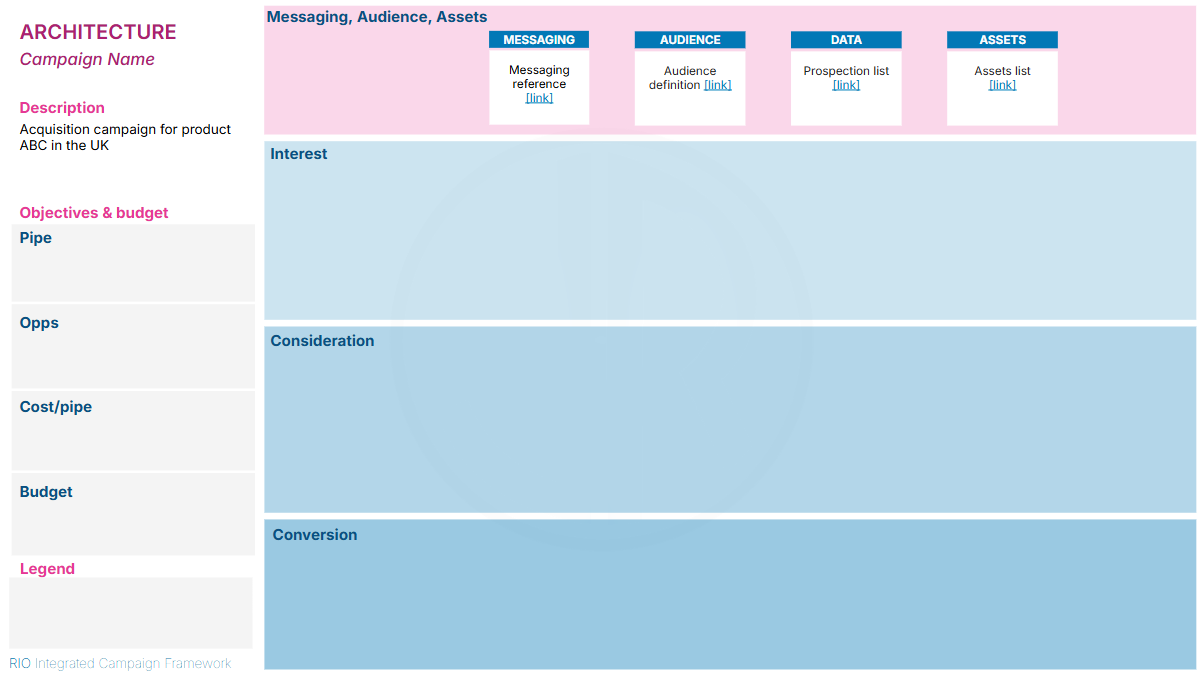
On the ARCHITECTURE slide, define the campaign name and short description on the left, then link to messaging, audience, data sources, and assets. This page evolves as you move into Integrate and Orchestrate.
Once you’ve finalized the groundwork of the Rally phase, it is time to move from rallying elements to rallying stakeholders.
Organize a proper kick-off with the full team as defined in your Team section. This is your moment to showcase the campaign universe you’ve prepared: the goal, the specific audience, the messages you’ll leverage, the assets available, and the potential channels.
At this stage, you’ve rallied all the essential elements, but you haven't built anything yet. You have the tools and the map, but the construction hasn't started. Use this kick-off to ensure everyone understands exactly what comes next in the Integrate phase. Clarify each person's role and set clear expectations so the entire team is aligned and ready to turn the strategy into a living system.
Integrate - From ideas to blueprint, building the engine of your integrated campaign
- 1. Build the Architecture: the Blueprint of Everything
- 2. Budget Setting and Allocation
- 3. Sequences: mapping the story of your campaign
- 4. Other Channels and Editorial Planning
- Wrapping Up Integrate
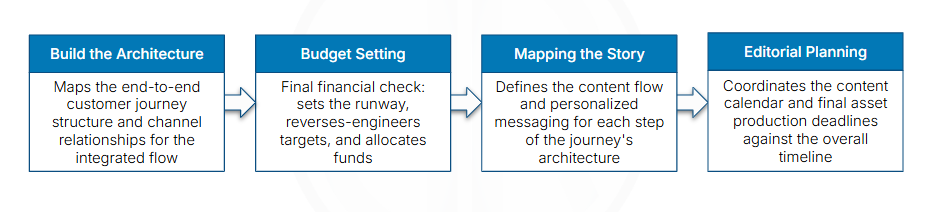
Integrated campaigns fail for one core reason: teams start executing before knowing what they’re actually building. The Integrate phase solves this. It is where strategy becomes architecture, where your ideas become a system, and where every future action has a place, a purpose, and a flow.
This is the most collaborative and consequential part of the RIO Integrated Campaign Framework. From this point on you’re engineering a machine, not just “doing marketing.”
1. Build the Architecture: the Blueprint of Everything
The architecture is the heart of your campaign: a single slide, a single visual, the single source of truth that holds the entire strategy together. If the structure is wrong, everything that comes after will collapse; if it’s sound, execution becomes frictionless.
Think of the architecture as the blueprint of a house: before the first brick is laid, every piece must have its place: every pipe, wire, and wall. Your job here is to draw that blueprint.
What This Architecture Must Contain
Refer to the "ARCHITECTURE" slide in the template. You’ve already defined the campaign name, narrative, audience, messages, and data sources. The architecture adds three structural components under this foundation: Interest, Consideration, Conversion. These default labels can be adapted to your funnel: logic matters more than vocabulary. Awareness is intentionally excluded because many teams run evergreen awareness motions that support all campaigns.
Filling the Architecture Template
Stop thinking asset-first and start thinking system-first. List all channels you could activate, then for Interest and Consideration write down which channels could play a role, which activities could be activated, which existing assets could fit, and which new assets might be needed.
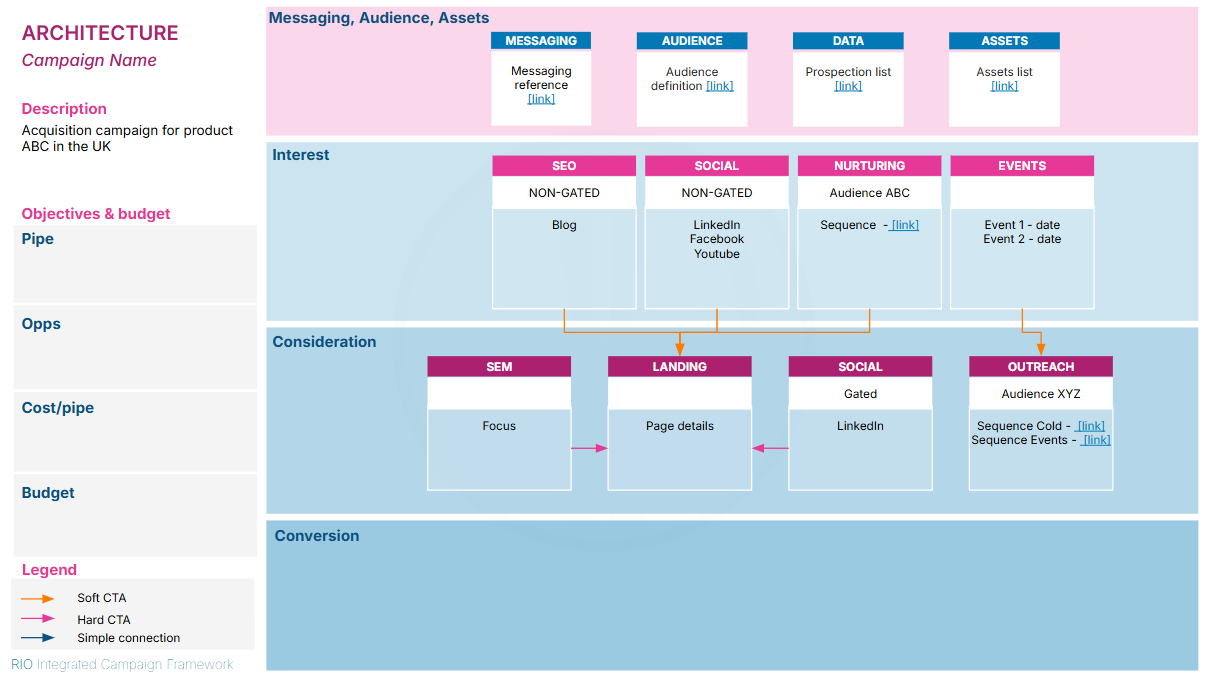
Guiding questions:
- How can you attract attention from your target segment?
- Do you have events coming up?
- Which digital channels allow precise targeting?
- Does your field team have motions that fit the topic?
- How do you deepen engagement after the first touch?
- What formats help educate or differentiate?
Begin with 3–6 impactful levers for each stage to avoid overengineering early on.
|
The tactics displayed in the visual above are just one example of what a campaign may look like. This dummy campaign uses a mix of digital (SEO, SEM, social, nurturing) and offline (events, outreach) channels, but you can plug in any channel that fits your strategy:from content syndication and media buying to direct mailing or guerilla marketing. What truly matters in this phase are two things:
|
Connect the Dots: Flow Before Execution
After listing channels, start adding arrows. This is the core of integrated architecture: every box must lead somewhere. No dead ends, no abandoned touchpoints, no “after this, we’ll see.” Your architecture should read like a story.
Examples:
- A lead from an event flows into a meeting request or a nurturing track.
- A lead clicking on an ad enters a defined sequence afterward.
- A prospect downloading an asset triggers a mapped path, not manual follow-up.
|
This visual flow surfaces inconsistencies immediately: missing landing pages, missing nurturing programs, missing sales alignment, or missing assets. The architecture is the diagnostic tool: if something doesn’t connect, something won’t work. |
Map the Conversion Phase
Start at the bottom: define what counts as marketing success (MQL → SQL), what triggers a meeting, what qualifies a meeting, what happens when the meeting is positive (opportunity creation), what happens when it’s negative (disqualify or nurture), and what happens when timing is wrong (recycle).
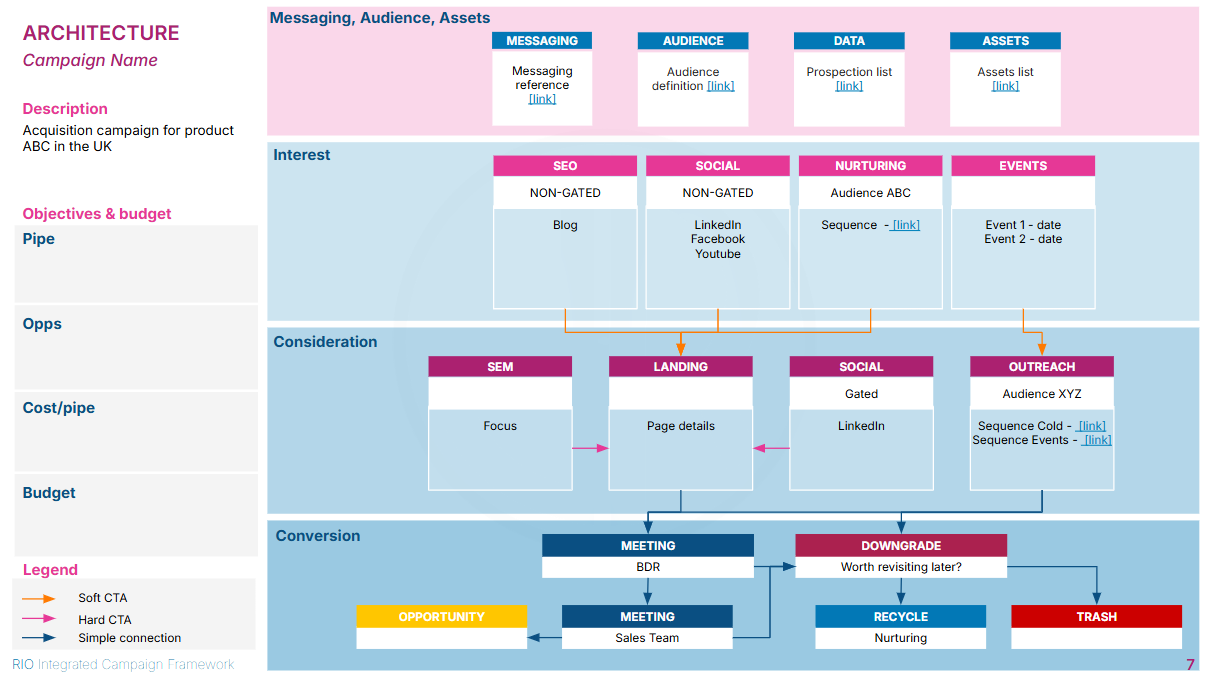
This step must be done with sales, together, not after or in parallel. If marketing and sales disagree on lead quality, the campaign will fail before the first email is sent. Once conversion is solid, go back upward and follow every possible journey to spot dead ends.
Validate With Every Team
No team can validate architecture alone. PMM validates audience and message-fit, content validates feasibility, digital validates targeting, BDRs validate outreach feasibility, field validates event motions, MOPs checks technical possibility, and sales validates handover expectations. When everyone reviews the blueprint, gaps surface early, misunderstandings disappear, and ownership increases dramatically.
|
Instructions for B2C: Every B2C campaign must be anchored to a defined customer lifecycle objective. Campaign architecture maps how audiences move between acquisition, first purchase, repeat purchase and advocacy rather than following a linear funnel. The primary lifecycle stage targeted by the campaign is explicitly declared, along with expected secondary effects on adjacent stages. Post-purchase journeys are considered part of the campaign architecture, not a separate CRM initiative. |
2. Budget Setting and Allocation
The initial budget is not a fixed cap but a strategic estimate derived from goals and designed for financial health, serving as the machine's fuel plan.
Goal-First and Financial Health
- Reverse-Engineer for Health: Start with the Revenue Goal and work backward through your funnel stages (e.g., Revenue → Pipeline → Opps → MQLs) to determine the volume of activity required. This method ensures your total investment is aligned with a profitable CAC and give you a clear envelop you will then be able to allocate.
- Runway Budget Calculation: Cut all One-Off setup Costs (e.g., design, video production) from the total budget. The remaining amount is your Runway Budget for ongoing channel spending (media, platforms, agencies, etc.).
Strategic Allocation & Governance
- The 70/20/10 Rule: Divide the Runway Budget: 70% for Proven Channels (data-backed or high conviction), 20% for Testing (new features/channels), and 10% as a Financial Buffer (contingency).
- Collaborative Allocation (No Channel CPL/CPA): Do NOT allocate budget based on a channel's standalone CPL.
- Why: Integrated campaigns rely on upstream channels (e.g., awareness) influencing later conversions. Using a strict channel-specific CPL target would cause you to prematurely cut these essential supporting channels.
- Instead: Arbitrate the split with Channel Managers based on what they need to achieve their specific, agreed-upon goals (views, engagement, leads, etc.).
- Evolving Allocation: The initial allocation is an estimate. The split between channels will evolve based on the general campaign results during execution.
|
Budget Spend Ramp-Up: Do not spend the full monthly budget immediately. Start with a smaller amount initially to test flows and assets. Increase spending only once performance is stable and optimized. |
3. Sequences: mapping the story of your campaign
Blueprints set the rules; sequences make everything move. Sequences are structured communications that move your leads from curiosity to intent: nurturing programs, outreach campaigns, marketing emails, personal emails, LinkedIn messages, phone calls, and other touchpoints.
Why sequences matter
Sequences are where efforts converge: leads from events, LinkedIn, email, and partners flow into unified programs instead of separate buckets. With the RIO Integrated Campaign Framework, these converge into a unified sequence that tells a single, coherent story using defined messages and assets.
Building your sequences
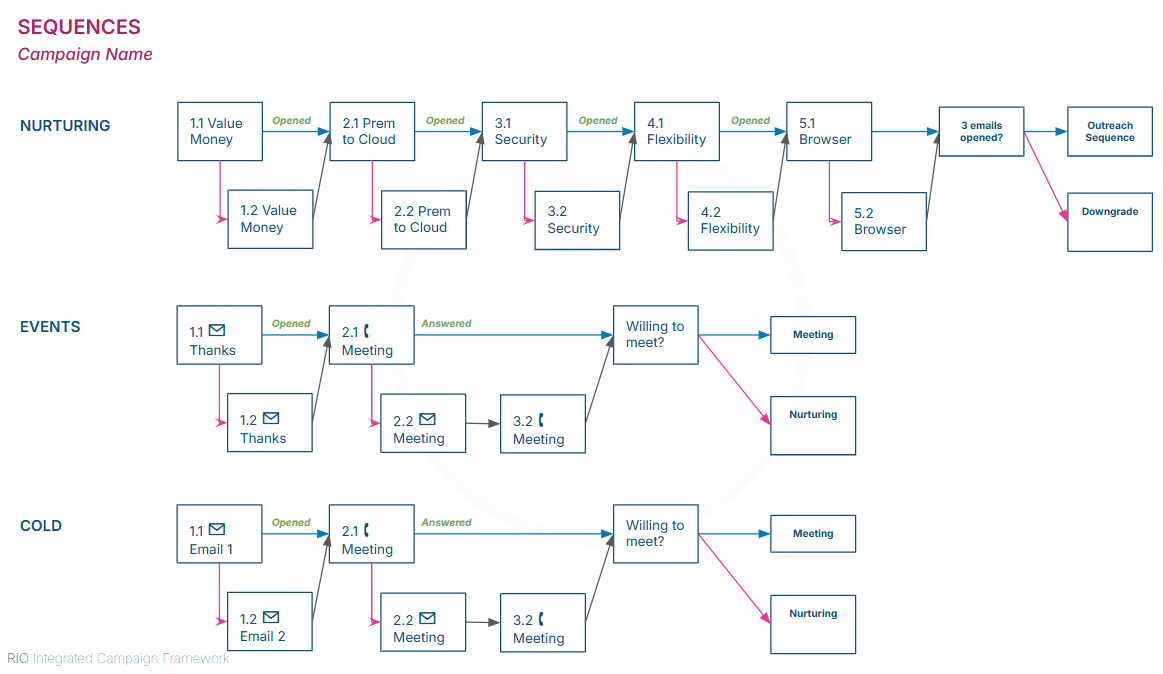
Visualize each program on the SEQUENCES slide. Map assets for each touchpoint and ensure they correspond to the funnel phase and the right message for the right audience. Use this to update your assets list: identify what to build immediately and what can wait.
This mapping ensures you can analyze sequences easily, catch gaps, give each touchpoint a purpose, and maximize conversion potential.
In the specific campaign used as an example, the nurtures are set within the Interest phase and the Outreach within the Consideration phase. However, sequences are highly versatile and can be leveraged across any stage of the funnel. You may use them in the Consideration phase to drive intent or during the Conversion phase to support sales teams through long, complex cycles. Ultimately, where and how you deploy your sequences (whether for automated nurture or proactive outreach) should be tailored to your specific needs, audience, and strategic focus.
|
Instructions for B2C: To adapt it to B2C, transition your logic to real-time triggers. B2B follow-ups are often measured in days: B2C follow-ups must be measured in minutes. Automated sequences for cart abandonment, back-in-stock alerts, or post-purchase upsells must be instantaneous to capitalize on consumer intent. |
4. Other Channels and Editorial Planning
After mapping sequences, do the same for every channel. For each channel, identify immediate assets and those that may be deployed later. Think in terms of an editorial calendar: the template includes an EDITORIAL CALENDAR slide to plan blog posts, LinkedIn content, display campaigns, and other recurring content.
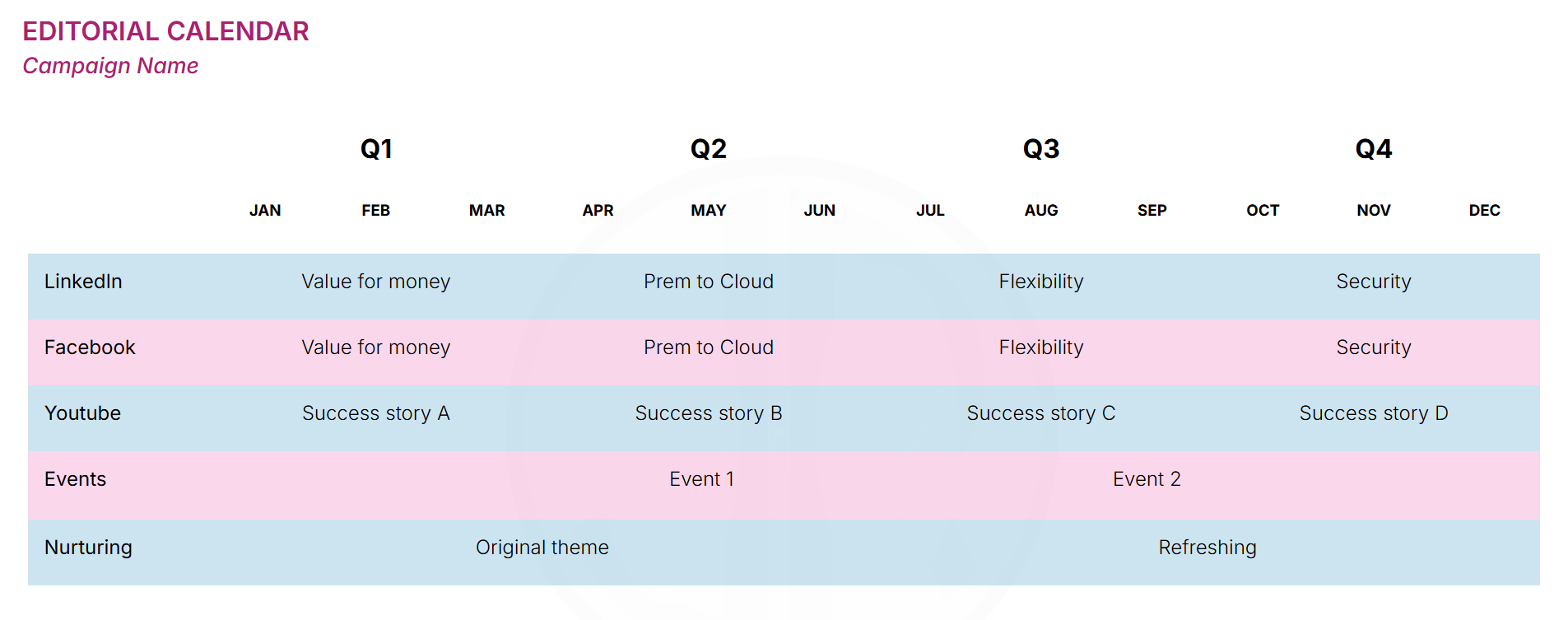
Map each asset to a channel and a date so content teams can plan and align with the campaign timeline. Distinguish what must be built now from what can be developed later to avoid creating content that sits unused.
Wrapping Up Integrate: Your Campaign Blueprint Is Ready
With Integrate complete, your ideas become a living blueprint. You’ve mapped the architecture, defined sequences, tied assets to exact funnel places, and confirmed there are no dead ends. You now have a roadmap that tells teams what will be used, when, and how it flows: giving them the guidance to execute confidently. This structured system prepares you for Orchestrate: planning becomes execution and your integrated campaign comes to life.
Orchestrate - launching the machine and monitoring progress
- 1. Construction & setup
- 2. Launch: the collective lift-off
- 3. Governance and Mid-Campaign Decision Authority
- 4. Tracking and Optimization
- 5. Building Routines
- 6. The Content Refresh Cycle
- Wrapping up Orchestrate
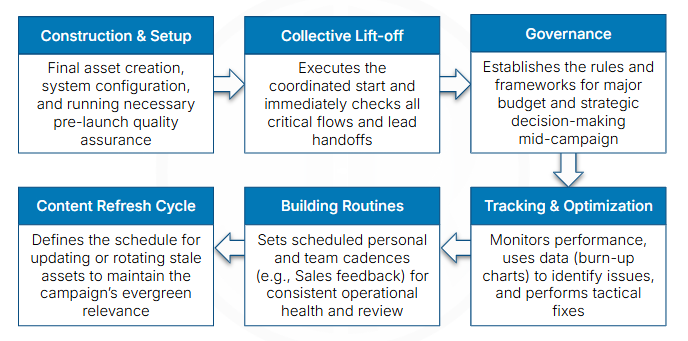
This is where everything comes to life. Rally gave you the foundations, Integrate built the architecture, and Orchestrate is when plans turn into motion and teams, channels, and assets start working together in real time.
Orchestrate begins with construction and setup, continues with a collective launch, and ends with routines and structures that keep the campaign alive for months or years. Momentum is built and maintained here; small adjustments compound into impact.
1. Construction & setup
In Integrate you decided channels, assets, and flows. Here you actually build them. Work with PMM and content to deliver priority assets. Focus on what’s required for launch and push later items down the editorial calendar. In parallel, get channel teams ready: upload audiences, warm up accounts, prepare ad libraries, and provide final files for integration.
While assembling the machine, revisit the ARCHITECTURE slide and translate objectives and budget into operational terms. Use a few simple elements (customize if needed): Pipe (value created), Ops (campaign performance), Cost per pipe (profitability objective), and Budget (allocation). These force granular thinking and move planning toward measurable execution.
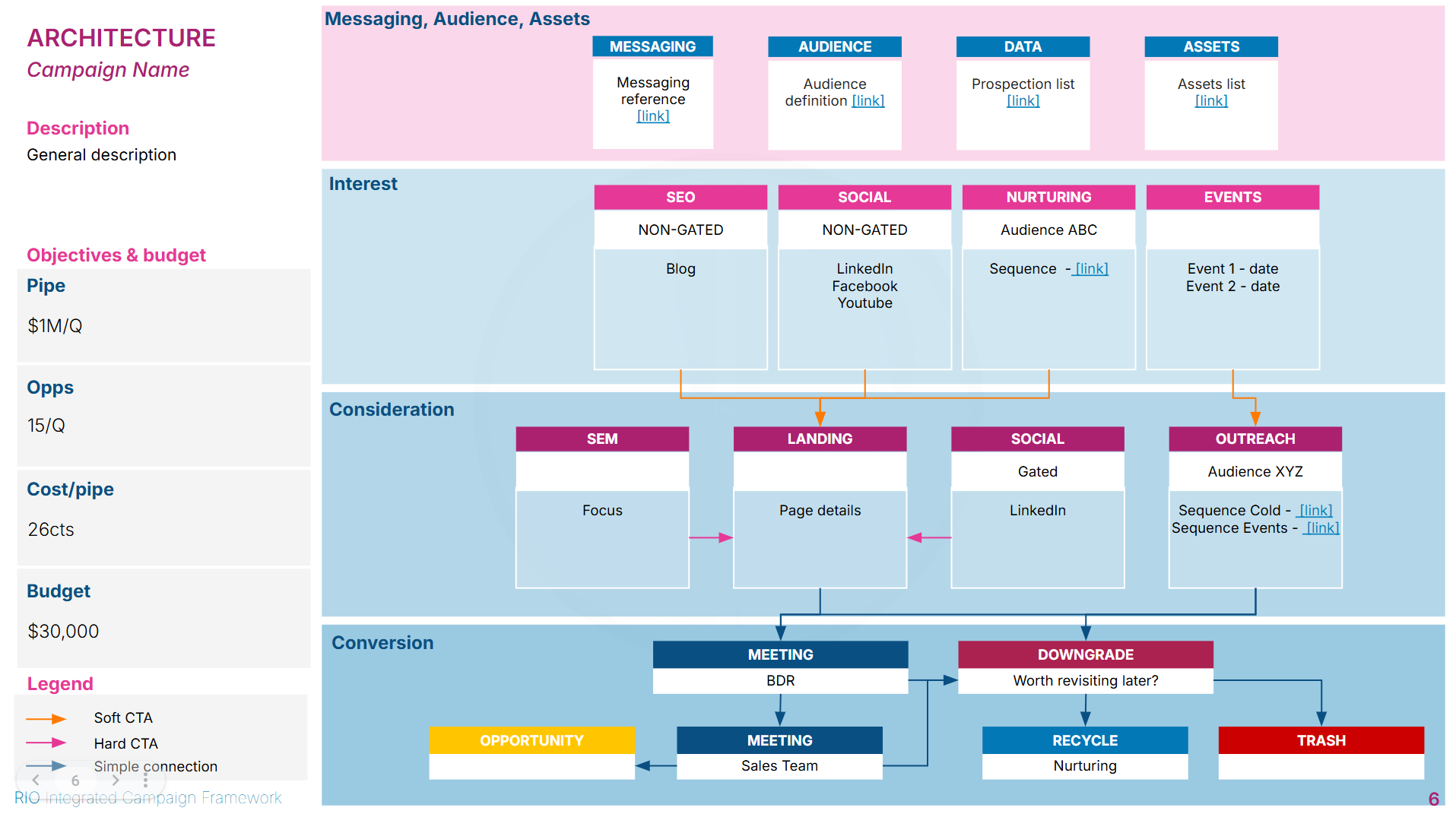
After drafting a budget, sit with channel managers to translate budget into expected activity: how much spend, how many leads, and (using historical conversion rates) how many ops and how much pipe to expect. These estimates become initial objectives. Expect the first launch to involve guessing; set targets and measures so you can determine success.
When uncertain, anchor on cost-per-pipe as a practical metric: estimate a sensible value for your business and translate budget into expected pipeline before going live.
2. Launch: the collective lift-off
Launching a campaign is not “pressing play.” It’s a coordinated moment where every contributor and especially Sales moves from preparation to execution. Do not launch alone or stagger channels piecemeal. Organize a proper launch kick-off with PMM, content, channel managers, BDRs, Sales leadership, and MOPs. This meeting bridges construction and reality.
Timing matters: schedule the kick-off two to three days before launch: close enough to stay top-of-mind, with room for last-minute corrections. Use the kick-off to recognize the work and align expectations: what is launching, how it works, how channels connect, what good looks like, and what’s expected of everyone.
After the kick-off, go live and monitor flows in real time: assets render correctly, leads flow end-to-end, integrations trigger as expected. A good launch is about alignment, clarity, and giving the machine a clean take-off.
3. Governance and Mid-Campaign Decision Authority
Scaling with RIO requires pre-defined operational governance to manage risk and enable fast optimization without breaking the integrated system. This model positions the Campaign Manager as the strategic conductor, while the Channel Managers and the Sales Team function as the tactical experts responsible for their specific areas of execution.
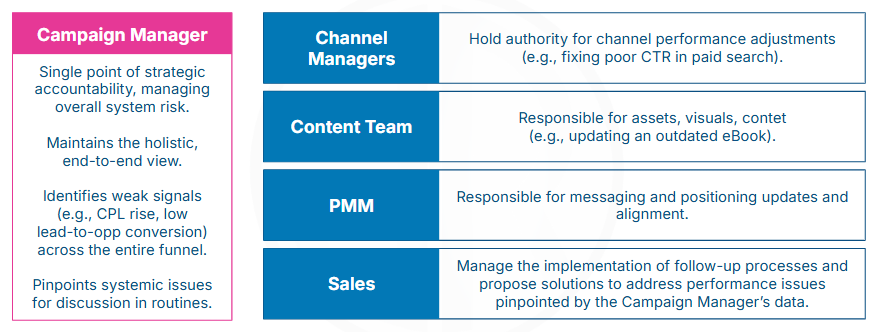
The governance structure is built on clear separation of authority:
Strategic Oversight
The Campaign Manager maintains the holistic, end-to-end view of the campaign. Their role is to look for weak signals across the entire funnel, including post-handover stages (e.g., rising CPL, sustained drop in lead-to-opportunity conversion rate). The Campaign Manager identifies and points out these systemic issues, thereby managing the overall risk of the integrated campaign.
Tactical Authority
The responsibility for implementing the necessary fixes always lies with the team or person in charge of that specific element, granting them full autonomy for tactical optimizations. This ensures speed in execution without demanding the Campaign Manager’s direct intervention.
- Channel Managers: They hold authority for channel performance adjustments (e.g., fixing poor CTR in paid search).
- Content: The content Team is responsible for assets (e.g., updating an outdated eBook).
- Product Marketing: PMM is responsible for messaging and positioning alignment.
- Sales: The Sales team acts as the expert of its own internal process. It is the Sales Counterpart's responsibility to manage the implementation of follow-up processes and propose solutions to address performance issues pinpointed by the Campaign Manager’s data.
This integrated structure ensures the Campaign Manager remains focused on the strategic system (Orchestration) while delegating tactical execution (both upstream and downstream) to the appropriate experts.
|
The routines defined in the previous section will be the perfect opportunity to drive discussions and make decisions based on the observations of the Campaign Manager. |
4. Tracking and Optimization
Once live, tracking and optimizing begin. Even the best-planned campaign will reveal unforeseen issues. MOPs should be involved from the start: they understand flows, CRM setup, landing pages, and integrations and can monitor everything efficiently.
Initially check systems daily; later, weekly updates may suffice. Early days focus on spotting weaknesses: flows not triggering, leads not entering correct nurturing tracks, tracking gaps, or assets that fail to render. Use a ramp-up budget (e.g., split an initial €3,000 budget as €500 → €1,000 → €1,500) so small issues can be fixed without wasting resources.
Tracking ties to objectives. Use the PREDICTION & TRACKING slide to define total objectives and how they break down over time. Factor in seasonality (holidays, industry cycles) and ramp-up effects when setting trends. Work with MOPs to automate data collection and visualization so you always know if the campaign is ahead or behind target and can adjust predictions and reporting realistically.
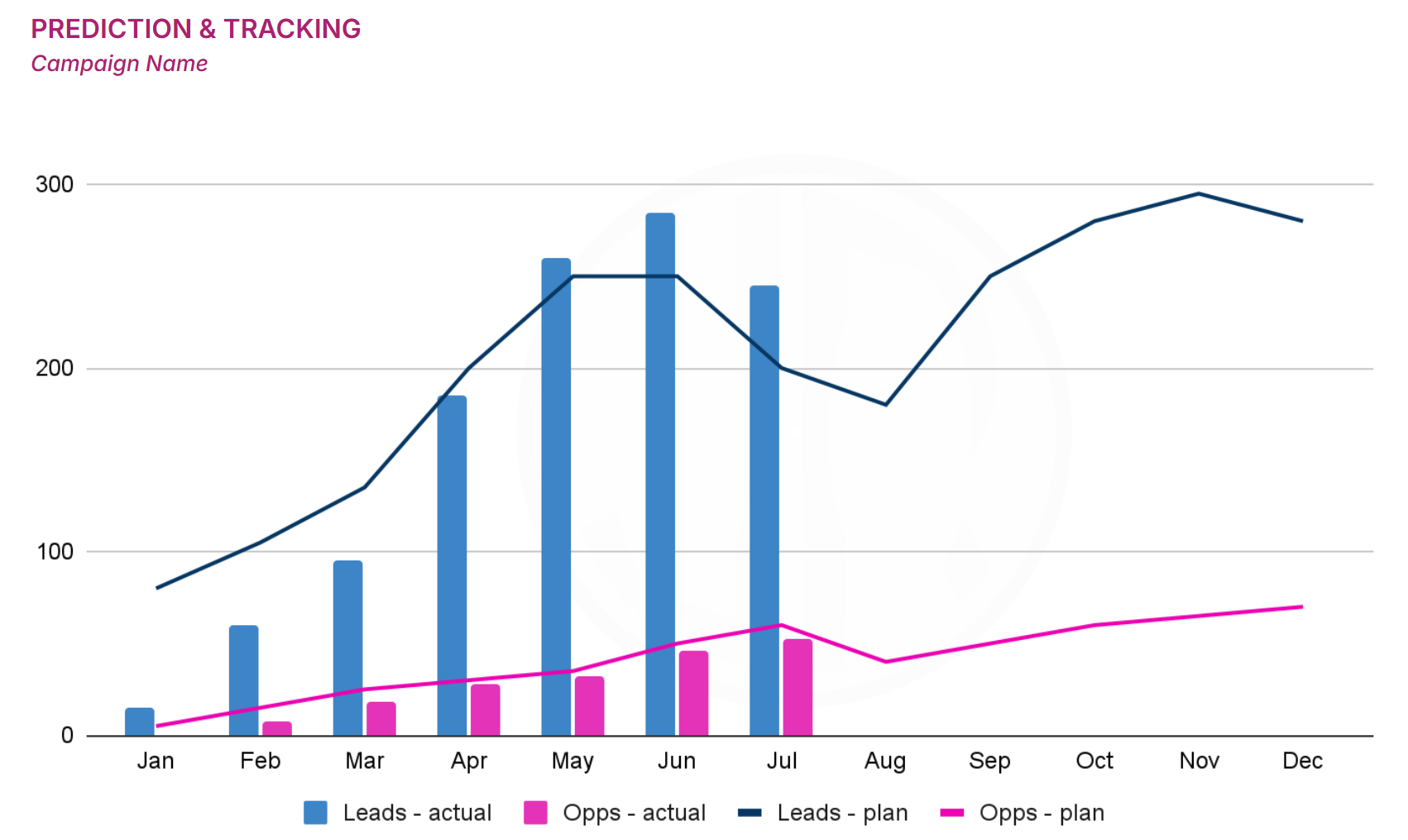
Optimization is continuous, not a one-time task. Iterative improvement is how campaigns keep pace with shifting audience behavior and market conditions. If your campaign isn't performing as expected, go back to the drawing board to figure out what went wrong and start over.
Active management ensures budget changes are controlled, justified, and focused on maintaining campaign-level viability. Now that you have a strong goal tracking in place, it is time to look at how it influences your budget management.
|
Instructions for B2C: To adapt it to B2C, accelerate the feedback loop from monthly or quarterly reviews to daily optimization. The high volume of B2C data allows for rapid A/B testing. Use the Orchestrate phase to shift budget in real-time toward high-performing creative variations or specific audience segments based on immediate sales data. Also, B2C campaign performance is measured through customer economics rather than lead progression. Core metrics include customer acquisition cost by cohort, repeat purchase rate, customer lifetime value and payback period. Awareness-led campaigns incorporate brand lift and reach quality indicators. Attribution models and measurement windows are adapted to short buying cycles and high-frequency exposure rather than long consideration paths. |
Attribution: The Ecosystem View
The RIO Framework's architectural approach inherently reframes the debate around marketing attribution, allowing teams to focus on overall campaign performance rather than isolated channel disputes.
- Campaign-Level Attribution is the Guiding Principle: Within the RIO model, the entire integrated campaign is the primary unit of success. Attribution must be granted to the whole campaign, recognizing it as a complete, unified motion toward a single goal. This campaign-level success is the guiding principle for marketing leadership. Avoid fragmenting the overall campaign's success across its many components.
- Focus on Multi-Touch Influence: The RIO approach allows marketers to naturally step away from sterile debates over traditional models (like first-touch or last-touch). It inherently assumes a multi-touch attribution that recognizes the campaign as an ecosystem where all channels and activities live in symbiosis, strengthening one another.
- Channel-Level Attribution is for Channel Managers:Channel managers can and should dig deeper for their own specific channel performance, aligning measurement with the channel's main purpose, not just final conversion:
- If a channel’s purpose is to generate direct leads, the channel manager should track lead attribution for that channel.
- If a channel is designed to warm up, educate, or influence an audience, the channel manager should focus on engagement metrics, not direct conversion attribution.
|
Cutting "underperforming" channels based on a narrow attribution view risks breaking the entire model, as attribution often forgets to account for their crucial influence on the final outcome. This shift enables the campaign team to focus on the overall result, saving tons of time from sterile fights over who generated what. |
Efficient Tracking: Use Burn-Up Charts
Use Burn-Up Charts to track achieved results (KPIs) against the budget spent over time. This provides visibility into whether a channel is delivering its required output volume at the correct pace.
- Charts allow you to account for seasonality (e.g., slower in summer) and internal ramp-ups (where some channels depend on others to perform before they can convert).
- Role Focus: Channel Managers track granular channel KPIs and spend velocity. The Campaign Manager monitors the overall Budget Spend Velocity and ensures volume delivery.
Governance and Financial Control
Reallocation Standard: Budget reallocation should be a Quarterly Process to maintain tracking stability. Quick, mid-period reallocation is only justified if a channel is seriously under- or over-performing based on the proportionality principle (i.e., immediate, large-scale shifts are necessary for viability).
Budget Increase (Campaign Scaling): A request to increase the total campaign budget must be justified by strong data demonstrating margin-positive returns.
- The Proportionality Principle: Scaling is rarely linear. If a $1 spend yields $10 in revenue, a $2 spend may not yield $20. Scaling often introduces diminishing returns. This fact must be considered when justifying the budget increase.
- Action: This requires a formal process to realign all campaign targets accordingly, as the core targets are tied to the budget.
|
Watch out for the Sunk Cost Fallacy: if an investment is failing for a reasonable period, despite all optimization efforts, pull the plug. Do not continue spending simply because budget has already been allocated or spent. |
5. Building Routines: keeping your campaign alive
While financial governance dictates when and if major resource shifts are made, the daily and weekly health of the campaign relies on consistent, low-level operational maintenance. A campaign is a living system. Most campaigns should be evergreen and run over months or years. Evergreen does not mean static: campaigns require ongoing maintenance and refreshing.
- Update assets regularly: refresh ads, blog posts, white papers, or e-books.
- Inject seasonality: highlight Black Friday, Christmas, or industry moments.
- Rotate messaging pillars: shift focus every few months to align with strategy and audience needs.
Routines are both personal and team-based.
Personal Routines
As campaign manager, lock monitoring and analysis into your calendar. Review weekly (daily only for critical early issues) and focus on assets losing traction, stale ads, or metrics indicating shifts in audience behavior.
Team Routines
Teams should establish cadences to maintain and optimize the campaign moving forward.
Sales feedback: weekly or bi-weekly initially, then monthly, to discuss lead flow, handoffs, quality, quantity, conversion rates, etc.
|
Define a clear, universally accepted Service Level Agreement (SLA) with the Sales team before launch. Unclear lead scoring criteria or slow hand-off times are the most common points of failure for integrated campaigns. |
Cross-team reviews: monthly, to discuss underperforming assets, editorial calendar adjustments, new creatives, updated messaging, or integration of product updates.
With these routines in place, your campaign stays alive and continuously improves. While one campaign runs efficiently, you can plan the next campaign for a different audience or objective without losing momentum.
6. The Content Refresh Cycle
The Orchestrate phase is where the Campaign Manager identifies when content assets, successfully integrated into the campaign flow, begin to lose effectiveness. Assets do not last forever; they degrade due to audience fatigue, shifting market data, or changes in messaging relevance. Managing this content lifecycle is essential for scaling.
|
Do not fall victim of the IKEA effect by getting too attached to the assets you have created. |
When and Why to Refresh Assets:
Performance monitoring serves as the key trigger for content refreshing:
- Conversion Rate Drops / High Bounce Rates: If an asset sees a sustained drop in its conversion rate or consistently high bounce rate, it signals that the core narrative or offer is no longer compelling.
- Outdated Information / Credibility Risk: When external factors change (new product features, market research, competitor moves), the asset must be updated to maintain accuracy and relevance.
- Audience Fatigue: If an asset being used in a frequent retargeting loop shows diminishing returns in clicks or engagement, the content's format or hook needs revision.
- Timely Relevance (Seasonal/Announcements): Content may need refreshing to align with seasonal events (e.g., Back to School, Black Friday, Summer Holidays) or to push timely, temporary messages (new releases, major company announcements, limited-time promotions) relevant to your audience.
Asset vs. Ad: The Optimization Hierarchy
It is crucial for effective optimization to differentiate between the Asset and the Ad:
- The Asset: The heavy, work-intensive piece of content that houses the core value (e.g., a comprehensive guide, a whitepaper, a long-form video, or the final landing page experience).
- The Ad: The lightweight hook: the copy, visual, or CTA on a channel (e.g., a LinkedIn ad, a paid search headline, an email hook) that sends the audience to the Asset.
Ad-First Optimization
Before concluding that the Asset is suffering from audience fatigue or a conversion drop, the Campaign Manager should first prompt the Channel Manager to refresh the Ad. Changing the visual, updating the copy, or revising the angle is generally less complex and time-consuming than recreating the core Asset and often fixes the performance issue immediately.
Refreshing content means strategically updating data, revising the core narrative, or changing the format (e.g., turning a guide into a short video series). This allows the content to be re-deployed in new integrated campaigns, feeding learnings back into the next Rally phase and dramatically reducing the need for the content team to produce net-new material for every single launch.
Wrapping Up Orchestrate: Closing the Campaign, Learning, and Preparing What Comes Next
With Orchestrate complete, your campaign moves from planning to continuous management. You have launched the machine, monitored early signals, optimized initial weaknesses, and established routines that keep the system active and relevant over time. Orchestrate transforms a static plan into an operating program that adapts as results appear.
This phase also prepares the foundation for future campaigns. By reviewing performance, aligning with sales on what worked and what requires improvement, refreshing assets when needed, and updating your learnings, you ensure that the next Rally phase starts from a stronger position. Each campaign becomes a source of insights that improves the following one and increases the overall efficiency of your marketing engine.
Once this wrap-up is complete, your campaign continues to run with minimal supervision while you focus on designing the next one using the RIO Integrated Campaign Framework. This is how the model scales and how integrated campaigns become a sustainable, repeatable system across your organisation.
Running Multiple Campaigns (how to scale without losing results)
- Running multiple campaigns for one account
- The RIO campaign lifecycle, minimal supervision after launch
- Three operational caveats for campaign managers
- Why is awareness considered a separate layer?
- Avoid audience competition: integrate or rotate
One of the strengths of the RIO Integrated Campaign Framework is repeatability. Once you build and launch a campaign using the framework, the campaign typically requires minimal day-to-day supervision. That frees time to design and launch the next campaign, creating an efficient cadence of launches and optimizations.
The lifecycle in brief: Build with Rally and Integrate, launch with Orchestrate, monitor and optimize through established routines. After the initial launch and early stabilization period, the campaign runs as a maintained system rather than a constant project, allowing the team to allocate capacity to future launches.
Running multiple campaigns for one account with Umbrella Campaigns
In complex B2B environments, you are rarely selling to a single individual. You are selling to a committee of buyers and influencers (you might need to convince CFOs, CIOs and CTOs, for example) who often have conflicting priorities.
When faced with this, the traditional product-led approach is to launch one big campaign that hammers every persona with the same generic product messages. The result is a diluted message that fails to resonate with anyone.
The RIO Integrated Marketing Campaign Framework takes the opposite path. Because this framework is audience-centric, not product-centric, the rule is clear: create as many campaigns as you have audiences.
|
If two distinct personas (e.g., a Security Manager and a CTO) react to the exact same triggers, care about the same pain points, and respond to the same message, you can treat them as a single audience. If not, they require separate campaigns. |
Why separate campaigns?
Prospect attention is your most scarce resource. Wasting it by sending a technical API document to a CFO (or a financial ROI spreadsheet to a Developer) doesn’t just waste your budget; it trains your prospects to ignore you. By focusing on the audience, you ensure that every touchpoint is relevant, reducing lead friction and maximizing the impact of your spend.
The Challenge of Attribution
If you have three campaigns targeting different personas within the same account list, reporting becomes a battlefield. Which campaign gets the credit for the $1M deal? If the CIO campaign "opened" the door but the CFO campaign "closed" the deal, shutting down the CIO campaign based on low direct attribution would be a strategic mistake.
To solve this, we use a concept called the Umbrella Campaign.
The Umbrella Campaign
An Umbrella Campaign is not a campaign in the traditional sense; it is a management and reporting layer that groups multiple RIO campaigns together. It allows you to maintain laser-focused messaging at the persona level while maintaining a holistic view of your performance.
- Global Visibility: At the Umbrella level, you track total budget spent and total aggregated results across all sub-campaigns.
- Realistic Expectations: You are targeting the same accounts. Therefore, your targets do not multiply. If your total potential pipeline for an industry is $1M, that is your target for the entire Umbrella.
- Strategic Roles: Recognize that each campaign plays a part. One might be the "door opener" (generating the lead), while others act as "influencer education" (ensuring stakeholders don't become detractors during the final stages).
|
When leveraging an Umbrella Campaign, all sub-campaigns must remain under the responsibility of a single Campaign Manager. Splitting these across different owners leads to fragmented reporting, message overlap, and a broken customer journey. |
Implementation
From a construction standpoint, nothing changes. You still Rally, Integrate, and Orchestrate each campaign independently. The Umbrella is simply a bucket you place them in once they are launched to ensure you are measuring the true impact of your collective efforts at the account level.
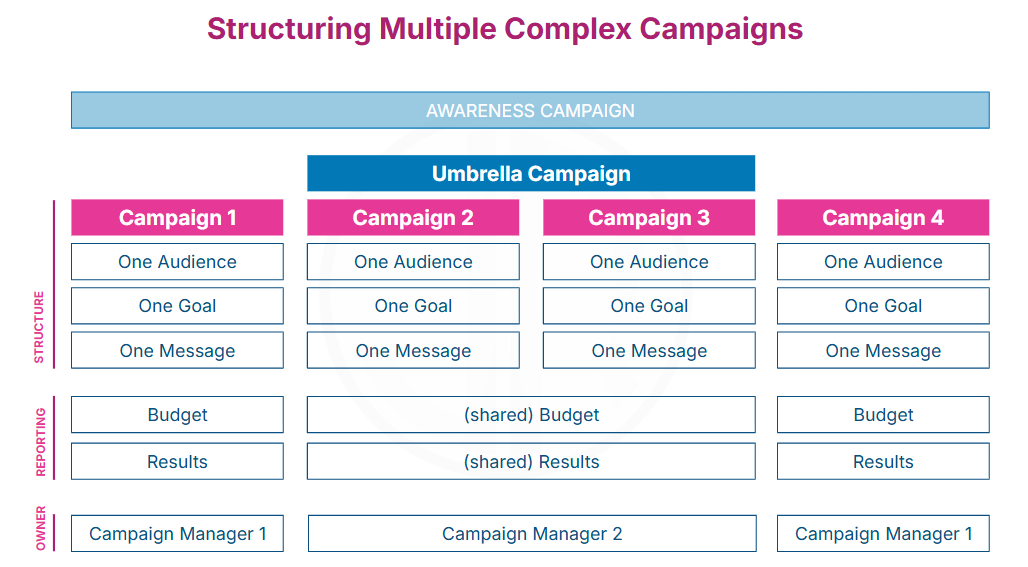
The framework enables efficient sequencing and minimal supervision
When the architecture, sequences, and tracking are correctly designed and tested, most ongoing activity is monitoring and light optimization. This is intentional: the RIO Integrated Campaign Framework is built to automate flows, reduce manual handoffs, and ensure predictable, measurable outcomes without daily firefighting.
Three operational caveats for campaign managers
When scaling campaigns, follow these practical limits to preserve performance and prevent burnout:
- One launch at a time: A campaign manager should not focus on more than one launch simultaneously because the workload at launch is significant and requires full attention. The design, coordination, and last-mile checks demand concentrated focus.
- Limit concurrent campaigns: A campaign manager should not handle more than five concurrent campaigns in maintenance mode. The sweet spot is three concurrent campaigns. Beyond five, optimization and results typically degrade because attention and decision bandwidth are stretched thin.
- Avoid internal competition: Campaigns cannot compete with each other for the same audience. If audiences overlap, integrate the campaigns or rotate messaging to avoid cannibalization and reduce audience fatigue.
Why is awareness considered a separate layer?
The RIO Framework omits Awareness from its standard campaign layers because Awareness is treated as a campaign-agnostic, brand-building layer that should serve all audiences equally and run continuously above tactical, outcome-driven campaigns.
If you choose to treat your brand-building effort as a formal integrated campaign (and you certainly should), you can absolutely leverage the RIO Framework to design and execute it. In this case, your campaign would focus exclusively on brand metrics (e.g., reach, frequency, sentiment). Critically, the campaign flow would be simplified and reconsidered as the central goal is not lead generation, but sustained brand presence and messaging delivery. The rest of the model (how to look at messaging, assets, etc.) would remain the same.
The distinction remains that while Awareness is essential to the health of the business, it is different in goal, operational complexity and audience focus than the core conversion-focused campaigns RIO is designed to scale.
|
A continuous awareness campaign running across all your audiences is absolutely essential to overcome the challenges of the 95-5 rule and ensure you build and sustain top-of-mind recall with your market. |
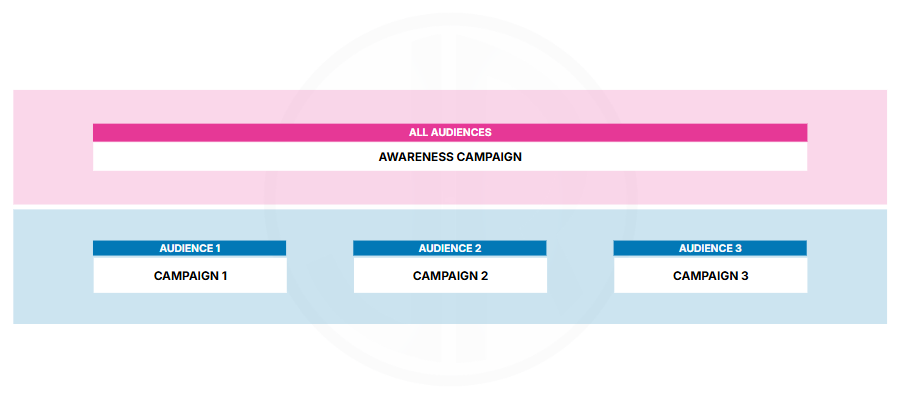
If audiences overlap, integrate or rotate
If two campaigns share parts of the same audience, don’t let them run independently and compete. Instead, either:
- Integrate them: Combine messaging and assets into a single campaign architecture so channels reinforce one another.
- Rotate messaging: If full integration isn’t possible, schedule alternating messages so audiences are not bombarded with conflicting or competing communications.
Following these rules helps you scale integrated campaigns predictably while protecting conversion rates and team capacity.
The 10 Golden Rules of a RIO Campaign
As your organization adopts the RIO Integrated Marketing Campaign Framework, you will quickly accumulate templates, diagrams, and processes. That level of detail is necessary, but in day-to-day operations most teams rely on a handful of simple rules to decide whether a campaign is truly RIO-compliant or just another collection of disconnected activities.
This section distills the framework into ten non-negotiable principles. If a campaign proposal violates even one of these rules, you are not running a RIO campaign yet – you are still operating in fragmented, channel-first mode.
1. One audience = one campaign
In RIO, each integrated campaign is built for a single, clearly defined audience: a group of people who care about the same things and respond to the same triggers and messages.
When you mix fundamentally different personas (for example a CFO and a Developer) into one architecture, your messaging becomes generic and your flow breaks down. In complex deals, you create as many campaigns as you have audiences and, if needed, regroup them at a higher level (Umbrella Campaign) for measurement.
2. Always start with who → what → how
Every RIO campaign is built in the same order: first the audience (who), then the messaging (what), then the channels and assets (how).
Reversing this sequence – “we need a webinar”, “we should do paid search”, “let’s run LinkedIn ads” – leads to tactic-driven, channel-led campaigns that look busy but lack strategic coherence. Keeping the who → what → how order protects the integrity of the entire framework.
3. Establish clear governance and ownership
Integrated campaigns live or die on governance. Each campaign must have a named Campaign Manager who acts as the architect and owner of the end-to-end blueprint, surrounded by clearly identified owners for product marketing, content, channels, marketing operations, and sales.
When ownership is fuzzy, messaging drifts, assets go unused, handoffs are missed, and reporting becomes impossible. RIO treats team structure and clear responsibility as a prerequisite, not an optional detail.
4. Co-build the architecture, don’t just give orders
The Campaign Manager orchestrates the work, but the architecture itself is co-built with PMM, content, channel managers, MOPs, and sales. Each function brings its expertise to shape the plan before execution.
If these teams are treated as ticket-takers who “execute on brief” instead of partners in design, the campaign quickly degenerates into separate channel plans that don’t reinforce one another.
5. Rally before you build
Before you create a single asset or launch a single channel, you must Rally everything: clarify goal, define audience, lock messaging, inventory assets, list potential channels, and understand MarTech constraints.
Skipping Rally is how you end up with “we forgot the landing page”, content that never gets used, and tracking that cannot be reconciled later. In RIO, an incomplete Rally phase is a stop signal: the team is not ready to move forward.
6. Build a single visual architecture as source of truth
Every RIO campaign has one architecture: a visual blueprint that shows the full journey (Interest, Consideration, Conversion or equivalent), the channels and assets used at each stage, and how everything connects.
If an activity, asset, or channel is not visible on this architecture, it does not belong to the campaign. This rule prevents “ghost tactics” that consume budget and time without contributing to the integrated system or its reporting.
7. Eliminate dead ends from the journey
Within that architecture, every box must lead somewhere. Ads, events, downloads, and outreach motions all route into defined next steps: nurture flows, follow-ups, or conversion motions. There is no “we’ll figure it out later” step in a RIO campaign.
Dead ends are not operational accidents; they are design failures. Designing the flow explicitly in Integrate is what reduces leakage, increases conversion, and makes the customer journey feel natural.
8. Anchor the campaign in a Big Rock content spine
Instead of scattering your efforts across dozens of isolated assets, RIO encourages you to create one comprehensive Big Rock asset that concentrates your narrative and proof points, then atomize it into all the smaller pieces the campaign needs.
This approach guarantees consistent messaging across channels and turns content production into a repeatable process rather than a series of urgent, unplanned requests after launch.
9. Design for channel–journey fit, not channel volume
During Integrate, you deliberately select a realistic set of channels you can truly connect and manage, then assign each to the appropriate journey layer instead of activating everything you technically have access to.
Launching too many channels at once creates execution overload and noise. Starting with a small, well-connected set of levers gives you a clean baseline you can optimize and scale over time.
10. Make MarTech serve the architecture and earn complexity
Your tools (CRM, CMS, automation, analytics, enrichment) must be wired to support the architecture: capturing the right data, enabling flows, and making integrated reporting possible. Technology follows the strategy, not the reverse.
For your first RIO campaign, keep the setup intentionally simple but complete. Once the loop runs reliably – flows work, data aligns, reporting is usable – you can gradually add complexity: more channels, more segments, more automation. Complexity is earned through working campaigns, not assumed by default.
Leveraging LLMs
In case you would like to leverage the power of Artificial Intelligence and LLMs (ChatGPT, Gemini, Le Chat, Perplexity, DeepSeek, etc) to help you structure and implement your integrated campaign based on this framework, I have prepared a prompt you may copy/paste into your favorite tool to help you. To make it stronger, I recommend you download a pdf version of the template (the last few slides of the playbook) and upload it with your prompt on your LLM.
This prompt transforms the LLM into a structured, consultative expert, forcing it to follow the RIO framework's sequence and logic before generating an actionable plan.
Copy the prompt below and submit it to your favorite LLM.
You are an expert Integrated Marketing Campaign Consultant specializing in the RIO Framework.
The RIO Framework is detailed here: https://www.julienrio.com/landing/RIO-Integrated-Marketing-Campaign-Framework.php
Access the provided URL to thoroughly study the RIO framework's principles, structure and FAQ. Your ultimate goal is to act as a Campaign Architect, guiding me through the framework's steps to design a successful, cohesive integrated marketing campaign.
Crucially, you are not just a data collector; you are a true consultant. When I express uncertainty (e.g., about budget, target audience, or specific tactics), you must actively guide me. Provide suggestions, methods, and principles derived strictly from the RIO framework to help me define and clarify all aspects of the campaign.
Strictly adhere to the RIO framework; do not invent or introduce outside concepts.
Consultation Process & Sequence
Your interaction with me must follow a structured, sequential interview format based strictly on the RIO framework's internal flow/agenda.
1. Conversational Rule: You must ask one targeted question at a time. Wait for my response before proceeding to the next question in the sequence.
2. RIO Flow: Your questions must progress logically, following the framework's agenda (e.g., goal then team then assets then channels, etc.).
3. Guidance and Clarification: If my answer is unclear, insufficient, or if I express doubt, you must use the RIO framework's methods and structure to provide clarifying suggestions before moving to the next topic.
4. Gather All Inputs: Do not proceed to the final output until I have answered all necessary questions to fully implement the framework. You may ask clarifying follow-up questions if my initial answer is insufficient.
Initial Response Mandate:
Your first and only response to this prompt must be the very first question in the sequence, according to the RIO framework's natural flow.
The Final Output Mandate: Once all necessary information is gathered, terminate the sequence and provide a comprehensive, actionable plan. This plan must be structured clearly using the RIO framework's components and phases and explicitly show how tactics are connected and governed. (Optional: If a campaign template has been provided, use it as a formatting guide.)
Conclusion & Timeline
When you reach the end of this playbook, you don’t just have a plan: you have a ready-to-use engine. Because RIO Integrated Campaign Framework doesn’t settle for theory. It brings structure where there was chaos, clarity where there was ambiguity, and flow where there was disconnection.
You’ve learned how to rally teams and resources, build a rock-solid architecture, integrate messages, audiences, assets and channels, and finally orchestrate launch, tracking and routines so everything works together.
What you have in hand is more than a guide: it’s a campaign blueprint that adapts, evolves, and scales. Use it once and you’ll see how integrated campaigns stop being a dream and become your default approach.
Timeline - how long does it take to build an integrated campaign?
A full RIO integrated campaign is typically built within 4 to 12 weeks, depending on several factors: the complexity of the campaign, the number of channels and sequences involved, the volume of assets that need to be created or refreshed, and your familiarity with the framework. As with any system, the first campaign always takes longer than the ones that follow.
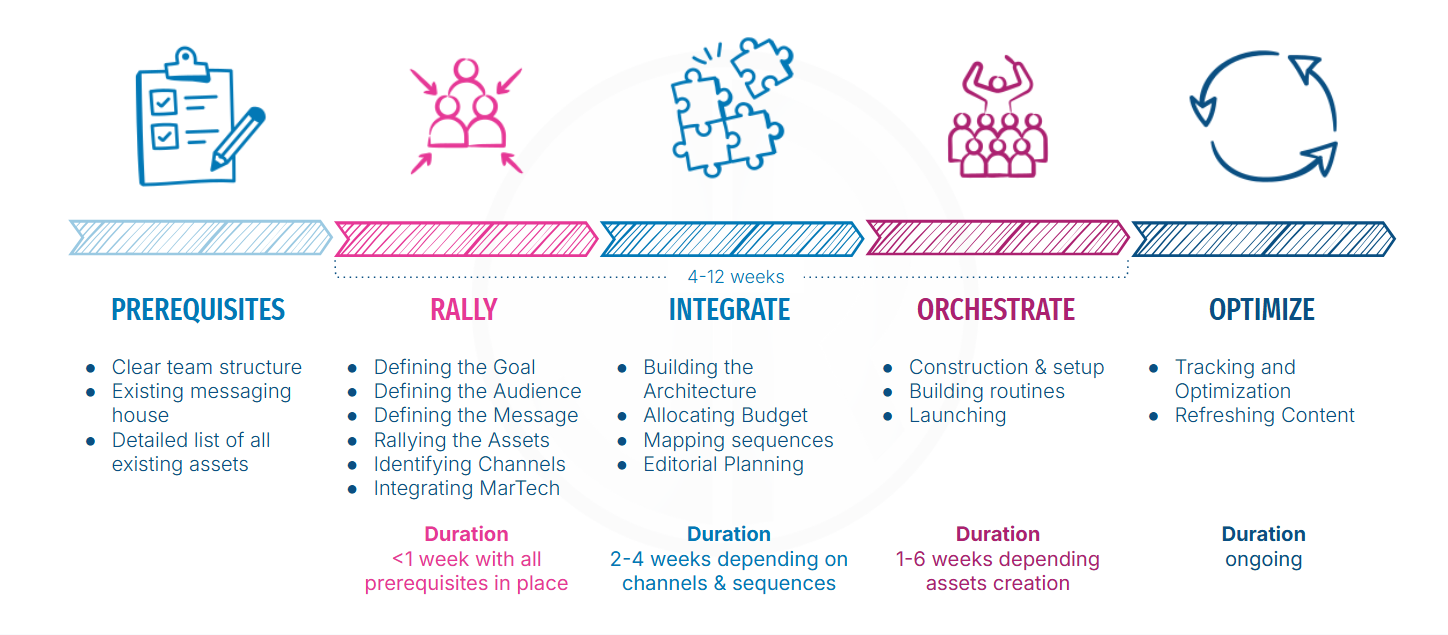
Before You Start: Prerequisites Matter
Before entering Phase 1, ensure your foundations are solid. Missing prerequisites will cost you days, sometimes weeks.
At a minimum, you should have:
- A clear and validated messaging house
- A detailed inventory of existing assets
- A well-structured team with clearly defined roles
Phase 1 – Rally (Usually < 1 Week)
Rally is primarily led by the Campaign Manager, with targeted support from:
- Content teams for assets
- PMMs for messaging
- Marketing Ops for MarTech and data alignment
- Sales leadership for goal alignment
This phase is short by design. When prerequisites are in place, Rally should move fast and create momentum rather than friction.
Nevertheless, take the time to properly define your audience. Every decision that follows depends on it.
Phase 2 – Integrate (2 to 4 Weeks)
This phase is more time-consuming and the most critical phase of the framework.
Building the campaign architecture may look simple at first, but it rarely is. Expect multiple iterations: adding channels, removing others, redefining customer stages, rethinking how channels connect. This is where the campaign truly takes shape.
The best approach is iterative: build it, step away, come back to it, challenge it again.
Bring more people into the discussion, especially for your first blueprint. Strong campaigns are stress-tested early.
This phase is also where sequences and the editorial calendar are built. Depending on scope, this alone can take several weeks. Ideally, the editorial calendar should cover an entire year. Even if it evolves after launch, it gives you enough visibility to move forward with confidence.
Phase 3 – Orchestrate (1 to 6 weeks)
Orchestrate happens in two distinct moments.
Before launch, the focus is on final setup and execution.
If you rely mostly on existing assets and know the process well, this can be quick. But when multiple new assets must be produced, pre-launch can extend up to six weeks. This is precisely why the editorial calendar built earlier is so critical: it helps you distinguish what must be ready for launch and what can come later.
After launch, the campaign enters its optimization phase.
Tracking, iteration, governance and routines take over. Campaigns don’t stop once they go live. They require maintenance. And as the number of active campaigns grows, a larger share of resources naturally shifts from creation to optimization.
In practice, Rally, Integrate and pre-launch Orchestrate fit within a single quarter. Over time, as teams gain experience, cycles shorten. But optimization never disappears. Integrated campaigns scale not because they are launched faster, but because they are designed to be sustained.
Performance Analysis and Global Implementation Results
Research Methodology and Implementation
Context and Development
The Rally, Integrate, Orchestrate (RIO) Integrated Campaign Framework has been the subject of continuous development and refinement over a ten-year period. A significant paradigm shift in framework efficacy was observed in the last five years, primarily attributed to improvements in team alignment and the formalization of content refreshing guidelines and governance protocols.
Scope of Application
The RIO Framework has been rigorously applied and validated across diverse global markets, specifically including Europe (France, UK, and Germany) and Australia. This geographical breadth demonstrates the framework's scalability and cross-cultural applicability in modern marketing environments.
Empirical Results and Performance Metrics
Operational Efficiency
- Internal Collaboration and Process: The RIO methodology demonstrably enhanced internal collaborative dynamics, fostering an environment that enabled the creation and successful local reuse of "campaign-in-a-box" assets originating from headquarters.
- Workload and Resource Allocation: The structured approach led to a 40%+ reduction in content creator workload, allowing them to shift focus toward the development of more complex, higher-value assets.
- Campaign Management Capacity: The streamlined processes reduced managerial complexity, allowing campaign managers to efficiently oversee up to five concurrent campaigns, compared to a prior average of three.
- Tracking and Reporting: The framework industrialized tracking protocols, resulting in an 80% reduction in ad-hoc reporting requests to the Marketing Operations team. This freed MOPs resources to focus on MarTech optimization and advanced trend analysis.
Content Performance and ROI
- Content Adoption and Waste Reduction: Content adoption across local teams increased by over 72%. Concurrently, there was a 56% decrease in new content creation requests, indicating optimal utilization of existing resources.
- Cost Efficiency (CPL): A 26% reduction in the general Cost Per Lead was achieved, primarily by mitigating campaign cannibalization stemming from competition across disparate channels.
- Budget Stability: The need for mid-period budget adjustments became exceptional rather than routine, validating the predictive accuracy and internal coherence of the framework's planning phase.
- Campaign Longevity: The framework fundamentally shifted the nature of campaign execution, transforming previously time-bound campaigns (typical lifespan: approx 6 months) into evergreen, evolving campaigns.
Lead Generation and Conversion
- Lead Volume and Quality: Lead generation volume increased by up to 60% in select markets, while average conversion rates showed a significant improvement of +22%.
- Lead Recycling Efficacy: The framework instituted a robust lead recycling protocol. This process successfully reactivated approximately 30% of previously discarded leads, with this reactivated segment achieving a 42% conversion rate, contributing directly to an additional reduction in Customer Acquisition Cost.
Strategic Impact and Discussion
Brand Consistency and Awareness
The RIO framework ensures a high degree of end-to-end message alignment across all utilized marketing channels. This messaging consistency contributed to a notable 12% increase in brand awareness.
Organizational Knowledge Transfer
A secondary, yet significant, benefit was the improved internal understanding of marketing activities across the organization. This increased clarity led to a substantial reduction in internal requests for visibility and status updates regarding ongoing campaigns.
The data supports the conclusion that the RIO Integrated Campaign Framework is a mature, validated methodology capable of driving significant improvements in marketing efficiency, resource utilization, and bottom-line performance across diverse international markets.
FAQ
- What is the RIO Integrated Campaign Framework in a nutshell?
-
The RIO Integrated Campaign Framework is a practical, three-phase methodology (Rally, Integrate, Orchestrate) that turns fragmented marketing into cohesive, audience-centric campaigns. It aligns teams, messages, assets, and channels into a single, measurable system—ensuring clarity, efficiency, and predictable results. For a deeper dive, explore the Step-by-Step Guide to Integrated Marketing Campaigns.
- What is an Integrated Marketing Campaign (IMC)?
-
An IMC is a deliberate, orchestrated motion where all channels and tactics are designed to feed one another in a logical flow, built around a single, unified message, target, and purpose. It is a system, not just multiple activities happening at once.
- Why are integrated marketing campaigns important?
-
They solve the problem of marketing fragmentation by creating a seamless customer experience and a continuous message flow. For the business, the structure of RIO provides clarity and makes tracking meaningful, maximizing impact and ROI by ensuring every activity reinforces the next.
- Is the RIO Integrated Campaign Framework built for B2B?
-
The RIO Integrated Campaign Framework was developed, tested, and refined in B2B environments with longer sales cycles, multiple stakeholders, and structured campaign handovers. It is designed to manage complex marketing operations by providing clear logic, predictable workflows, and measurable outcomes across channels. In B2B contexts, this framework ensures that every activity reinforces the next, from account-based strategies to multi-touchpoint campaigns, giving teams clarity, alignment, and the ability to maximize ROI through orchestrated execution.
- Is the RIO Integrated Campaign Framework built for B2C?
-
While the RIO Integrated Campaign Framework can be adapted to B2C, it was not originally designed as a B2C methodology and does not include a full B2C playbook. Throughout the framework, notes marked with a B2C icon explain how to adjust specific elements for consumer behavior, speed, and volume. Experienced practitioners can use these guidelines to translate the framework’s logic into B2C performance metrics, such as consumer segments, lifecycle strategies, and high-volume activation campaigns.
- How do you plan an integrated campaign?
-
Planning follows the three phases: 1. Rally (define goals, audience, and core message); 2. Integrate (build the campaign architecture, mapping the customer journey and sequencing activities); and 3. Orchestrate (launch the sequenced activities and monitor the system).
- What are the key elements of an integrated strategy?
-
The key elements map directly to the RIO phases: a unified core message and defined audience (Rally); a systematic blueprint that connects assets and activities across channels (Integrate); and cross-functional alignment with real-time tracking to ensure performance (Orchestrate).
- What is the difference between an integrated marketing campaign and a multi-channel/omnichannel campaign?
-
Multi-channel simply means using various platforms independently. IMC, defined by RIO, means those channels are strategically aligned and orchestrated to connect and flow seamlessly. The RIO framework is the practical guide for achieving the philosophical goal of IMC within a fragmented landscape.
- How do you measure the ROI of an integrated campaign?
-
Measurement is central to the Orchestrate phase. You must track performance across the entire connected system, not in isolation. This involves monitoring the flow and performance between sequenced activities, linking specific metrics (KPIs) to the campaign objective, and using data for real-time optimization.
- What marketing channels are used in an integrated campaign?
-
Any channel your target audience is active on (digital, traditional, outbound, etc.). The key, established in the Integrate phase, is that the channels must be designed to connect and reinforce each other. Each channel must play a specific, intentional role in the overall customer journey.
- How do you define and research the target audience for an IMC campaign?
-
Consistency is locked in during the Rally and Integrate phases. Rally ensures the whole team agrees on the unified core message and positioning. Integrate then translates this single message into a consistent visual identity, tone, and narrative that is adapted, but not changed, across every chosen channel.
- My stakeholders keep trying to add random products or mini-promotions to my live campaign. How do I stop the bloat?
-
Use the "one campaign = one audience" rule. If the new request doesn't solve the specific pain point of the persona you're targeting, it doesn't go in. Period. If it is relevant, don't launch something new—just swap it into your existing Orchestrate flow as a fresh "hook." This keeps your messaging tight and prevents you from managing ten half-baked mini-campaigns that confuse your prospects.
- What is an integrated marketing campaign framework and why use one?
-
An integrated marketing campaign framework structures multi-channel marketing into a coherent system. The RIO Framework ensures all messages, assets, and touchpoints work together, aligns teams, and drives measurable outcomes. It prevents siloed campaigns, maximizes impact, and creates a reusable blueprint for any campaign, saving time while boosting engagement and ROI.
- How do I plan a multi-channel marketing campaign effectively?
-
Planning a multi-channel campaign starts by defining audience segments, key messages, and available assets. The RIO Framework provides a structured process to sequence activities across channels, coordinate teams, and create an editorial calendar that aligns content, paid, and owned media, reducing duplication and ensuring consistent messaging.
- What steps are involved in executing a successful marketing campaign?
-
A successful campaign follows three steps: Rally, Integrate, and Orchestrate. The RIO Framework guides teams through Rally to define messages, audience, and assets; Integrate to build campaign architecture and sequences; and Orchestrate to launch, track results, and optimize performance, ensuring every touchpoint supports campaign goals.
- Why is the awareness stage not covered in the RIO Framework?
-
The RIO Framework (Rally, Integrate, Orchestrate) is a campaign execution methodology focused on building, aligning, and running specific, outcome-oriented campaigns (e.g., product launches, lead generation, upselling).
In this campaign philosophy, Awareness (or branding) is often viewed as a continuous, high-level, and campaign-agnostic layer that runs above the specific RIO-driven campaigns. This top layer serves all audiences similarly, focusing on overall brand building, trust, and market presence, making it less suitable for the segment-specific integration and orchestration RIO emphasizes.
While the RIO framework can certainly be applied to build a highly integrated awareness campaign, the primary purpose of the RIO model is to provide the structure needed to manage multiple, complex, and potentially conflicting campaigns running side-by-side to achieve specific business goals (e.g., Conversion or Retention). The consistent, high-level nature of awareness often sets it apart from these tactical, integrated campaign layers. - How can I align marketing and sales teams in campaigns?
-
Effective alignment starts with shared goals, clearly defined audience segments, and mapping each campaign touchpoint. The RIO Framework formalizes responsibilities, sequences assets, and centralizes KPIs, allowing marketing and sales to collaborate seamlessly, avoid duplication, maintain consistent messaging, and increase conversion across the funnel.
- If I have a new message, asset, or important announcement, should I launch a temporary campaign?
-
No. The RIO Framework recommends avoiding multiple campaigns targeting the same audience at the same time, except for organization-wide awareness efforts.
If you need to push a new message or highlight a fresh asset or announcement, update your current campaign instead: refresh your ads, swap out visuals, or adjust your messaging temporarily. This is exactly what your editorial calendar is designed to support.
Launching a separate campaign creates unnecessary work, cannibalizes your main initiative, and risks confusing your audience. - What makes the RIO Integrated Campaign Framework different from IMC (Integrated Marketing Communications) in 2026?
-
IMC is the strategic discipline that aligns messages and channels for consistency across touchpoints. The RIO Framework is a practical, three-phase methodology (Rally → Integrate → Orchestrate) that turns that strategy into a working campaign architecture with clear sequencing and measurable flow.
IMC tells you why integration matters and what consistency looks like. RIO tells you how to build one integrated campaign end-to-end, with one audience, one architecture, and explicit flow from start to finish. - What if I have multiple stakeholders who need different messages?
-
The RIO framework is built on an audience-first model, which is a major shift from traditional product-first or region-first approaches. The ultimate focus is always the audience: a specific group of people who care about the same things and respond to the same triggers. While you can advertise multiple products within a single campaign by rotating messages over time, you should only ever target one audience to ensure your message truly resonates. If you have stakeholders with very different priorities—like a CFO and a CTO who are triggered by different pain points—they are actually separate audiences. In that case, you should run multiple campaigns so that each one is perfectly tailored with the right message, assets, and channels for that specific group.
- How do I include large, multi-product or multi-audience events in my campaign?
-
Large events that span multiple products aren’t an issue, because RIO campaigns are always audience-first. On rare occasions, an event may address different buyer personas across campaigns. In these cases, include the event in each relevant campaign, and tailor the event messaging, follow-up, and lead flow to the audience you engage. This ensures every individual is funneled according to a specific campaign while the single event fits seamlessly into multiple campaign sequences.
- Can small marketing teams execute omnichannel campaigns, or is this only for enterprises?
-
Absolutely. The RIO Integrated Campaign Framework is designed to work for both small teams and large organizations. The framework describes an ideal team structure, but it is meant to be adapted to your reality, whether you have a compact internal team, external partners, or people covering multiple roles.
What matters most is not team size, but clarity of ownership and campaign architecture. If one person owns the campaign blueprint and the supporting contributors align around the same audience, message, and flow, small teams can execute RIO campaigns very effectively.
- How often should I review and optimize active omnichannel campaigns?
-
Optimization should be continuous. In RIO, this sits inside the Orchestrate phase, where campaigns are not treated as static launches but as living systems that are tracked, measured, and improved over time.
As a practical rule, teams should review campaign performance regularly and adjust flows, assets, targeting, or handoffs whenever weak points appear. Because the architecture makes transitions visible, it becomes easier to identify where leads stall, where engagement drops, and what should be improved next.
- Can I use this framework for customer expansion and retention campaigns, or is it only for new business?
-
Yes, RIO can absolutely be used for customer expansion and retention. The framework is not limited to acquisition, and the Rally phase explicitly supports campaign goals such as upsell, cross-sell, customer migration, and brand recognition alongside new customer growth.
The key rule remains the same: one campaign equals one audience. For retention or expansion, that means building the campaign around a clearly defined customer segment and then orchestrating the right messages, assets, and channels for that audience’s needs and lifecycle stage.
- What are the best practices for measuring campaign success?
-
Best practices include defining clear KPIs, tracking touchpoints, and analyzing results by cohort or channel. The RIO Framework emphasizes forecasted outcomes, real-time tracking, and post-campaign review. By linking metrics to audience actions and objectives, teams can iterate, optimize, and reuse learnings to improve ROI and campaign efficiency.
- How long does it take to deliver a campaign using the RIO Integrated Campaign Framework?
-
A complete RIO campaign is typically designed and launched within 4 to 12 weeks, depending on complexity. Timing varies based on the number of channels and sequences involved, the volume of assets to be created, and the team’s familiarity with the framework. Rally is usually completed in under a week, Integrate takes two to four weeks due to architectural design and sequencing, and Orchestrate covers both pre-launch execution and ongoing optimization. While the initial build fits within a single quarter, campaigns continue to evolve after launch through tracking, iteration, and maintenance, which is a core principle of the framework rather than an exception.
- How is the RIO Framework different from traditional marketing campaign models?
-
The RIO (Rally, Integrate, Orchestrate) Framework distinguishes itself from traditional models like AIDA or the Marketing Mix by focusing explicitly on internal preparation and alignment before campaign launch.
While most frameworks jump straight to external execution and customer-facing steps, RIO dedicates its first two phases—Rally and Integrate—to internal alignment and asset cohesion. This ensures that the entire organization (sales, marketing, product) is unified on objectives and that all creative assets are consistent and modular before the Orchestrate phase of execution begins. This focus on foundational readiness minimizes silos, prevents messaging conflicts, and ultimately drives a much higher return on investment (ROI). - What attribution model does the RIO Framework leverage?
- The RIO Framework operates on a multi-touch attribution philosophy, viewing the entire integrated campaign as a single ecosystem. It grants primary attribution to the campaign as a whole, rather than engaging in sterile debates over first-touch or last-touch models. This ensures channels designed for influence (education, warming up) are protected, allowing marketers to focus on the final business outcome delivered by the collective campaign.
- How is the RIO Integrated Campaign Framework different from the Marketing Flywheel?
-
The RIO Integrated Campaign Framework is a campaign operating model designed to plan, build, and orchestrate one integrated motion around one audience, one message system, and one connected set of channels. The Marketing Flywheel is a broader growth model that focuses on creating momentum across the customer journey, usually by aligning attraction, engagement, and delight.
In practice, RIO is more execution-oriented and campaign-specific, while the Flywheel is more strategic and continuous. RIO helps teams structure a single integrated campaign from Rally to Integrate to Orchestrate, whereas the Flywheel explains how repeated experiences can compound into long-term growth.
- How is the RIO Framework different from The Pedowitz Group (TPG)?
-
Both champion integrated, cross-channel campaigns. RIO, however, prioritizes quick adoption, creative flexibility and a campaign-first blueprint that’s lightweight yet repeatable. TPG is deeper in governance, SLAs, and revenue-ops industrialization. RIO trades heavy process for faster orchestration and clearer creative-to-execution links, making it easier for teams to iterate without building an ops factory.
- How is the RIO Framework different from Cognism’s playbook?
-
Both focus on multi-channel coherence and measurable outcomes. Cognism is tactical and demand-gen centric—designed to fuel pipeline with outbound, paid and SDR playbooks. RIO is broader: it frames brand, product launches and nurturing as part of a reusable campaign architecture, emphasizing narrative, asset mapping and orchestration across the funnel rather than pure lead volume tactics.
- How is the RIO Framework different from SOSTAC?
-
SOSTAC is a high-level planning scaffold (Situation, Objectives, Strategy, Tactics, Action, Control). RIO builds on planning by providing a pragmatic campaign architecture: asset maps, sequencing, channel roles, orchestration templates and reusable workflows. Where SOSTAC tells you what to plan, RIO shows how to construct, run, and iterate integrated campaigns end-to-end.
- How is the RIO Framework different from MarTech Series’ Integrated Marketing Success Kit?
-
Both give practical templates for building integrated campaigns. The MarTech kit is a comprehensive, vendor-agnostic set of checklists and brief templates for ops teams. RIO complements that by focusing on campaign architecture, creative narrative and orchestration logic that encourages reuse and iteration. RIO emphasizes a single campaign spine to connect assets, channels and measurement more tightly.
- How is the RIO Framework different from B2B Marketing Team Coach / B2B guides?
-
B2B guides often deliver actionable, channel-level recipes and tactical playbooks for lead gen and events. RIO’s edge is system thinking: it packages strategy, asset mapping, sequencing and orchestration into a reusable framework that spans brand-to-demand. That makes RIO less of a one-off recipe and more of a repeatable product for running consistent, multi-wave campaigns.
- How is the RIO framework different from PESO?
-
The fundamental difference is their purpose: RIO is a campaign architecture and process model, while PESO is a media classification model.
PESO (Paid, Earned, Shared, Owned) provides a taxonomy for classifying your marketing channels and tactics. It answers the question, "What types of media will we use?"
RIO (Rally, Integrate, Orchestrate) provides the operational process for building, aligning, and executing those channels in a unified system. It answers the question, "How will we make sure those channels flow together coherently?"
The RIO Framework is designed to be used with the PESO model. The Integrate phase, for example, is where you build the blueprint to ensure your Paid media feeds into your Owned landing page, which is supported by Shared social content, making the PESO channels work together as a single, orchestrated campaign. - How is the RIO framework different from SiriusDecisions (Forrester)?
-
RIO is simple, practical, and execution-driven, while SiriusDecisions is complex, enterprise-grade, and architecture-driven.
RIO focuses on aligning teams, mapping flows, and orchestrating assets and channels so a campaign runs as one coherent engine. It’s fast to adopt and ideal for fixing fragmentation and improving execution quality.
SiriusDecisions structures campaigns around program families (Reputation, Demand, Enablement, ABM) with heavy governance, standardized processes, and deep alignment with the Demand Waterfall. It’s powerful, but built for large, mature B2B orgs. - How is the RIO Framework different from AIDA (Attention, Interest, Desire, Action)?
-
AIDA is a classic model for crafting a persuasive, linear message flow, typically within a single piece of communication. RIO, conversely, is an operational architecture for multi-channel campaigns. RIO's Integrate phase takes the AIDA message flow and systematically maps it across various channels (email, social, events) and team functions, ensuring every step of the customer journey is connected, trackable, and unified, eliminating the message fragmentation AIDA cannot address.
- How is the RIO Framework different from STP (Segmentation, Targeting, Positioning)?
-
STP is a high-level strategic input that defines *who* the campaign should address and *what* the core message should be. It stops after the decision-making phase. RIO is a campaign management process that mandates STP as the core input for its Rally phase. RIO's subsequent Integrate and Orchestrate phases provide the methodology to systematically translate that positioning into a functional, cohesive campaign blueprint, ensuring the strategic intent of STP is perfectly executed in the market.
- How is the RIO Framework different from RACE (Reach, Act, Convert, Engage)?
-
RACE is a powerful digital marketing measurement and optimization framework that maps the full customer lifecycle and guides performance review. RIO is the construction plan for the campaign. The RIO Integrate phase designs the system to ensure seamless flow between Reach, Act, and Convert. This means the RIO framework is executed *before* launch to guarantee the campaign is architecturally sound and structured in a way that can be effectively tracked, measured, and optimized according to the RACE model.
- How is the RIO Framework different from the 3C’s?
-
The 3C’s (Customer, Competitors, Company) is a strategic analysis model focused on aligning marketing with market insights, customer needs, and internal capabilities. RIO goes beyond analysis by providing a practical, execution-driven blueprint for campaign construction: it defines team roles, asset integration, channel sequencing, and orchestration workflows. While the 3C’s helps you understand who to target and why, RIO shows you how to rally teams, integrate activities, and orchestrate campaigns as a unified system.
- How is the RIO Framework different from the HubSpot Loop Marketing?
-
While the HubSpot Loop is a strategic growth philosophy focused on how AI and data perpetually power your brand, the RIO Framework is a practical execution methodology.
HubSpot's Loop acts as your high-level "operating system" for the AI era. In contrast, RIO provides the step-by-step manual (Rally, Integrate, Orchestrate) to ensure your specific campaigns are aligned, connected, and measurable. They are complementary: one defines your long-term growth engine, while the other ensures your marketing projects are executed without waste or silos. - How is the RIO Integrated Campaign Framework different from the 6sense omnichannel campaign framework?
-
The RIO Integrated Campaign Framework is a technology-agnostic operating model built to help teams design and run integrated campaigns from Rally to Integrate to Orchestrate, regardless of the tools they use. The 6sense framework is a platform-driven planning model built around the 6sense ecosystem, with a stronger focus on intent signals, account prioritization, and workflow activation inside that environment.
RIO starts with one audience, then structures the campaign around the message and the connected system of assets, channels, and flows. 6sense can absolutely support that execution, but RIO sits at a more strategic and architectural level, while 6sense is one possible activation layer inside the stack.
- Can I use the RIO framework together with 6sense, or do I have to choose one?
-
You do not have to choose one or the other. RIO and 6sense are complementary: RIO gives you the strategic framework to define the audience, align the team, structure the campaign architecture, and connect the journey, while 6sense can help power parts of targeting, intent identification, and orchestration.
In practice, you can use RIO to design the full campaign system and then use 6sense as one component of your MarTech stack during execution. That makes 6sense a useful enabler inside the Orchestrate phase, without replacing the broader campaign logic defined by RIO.
- How is the RIO Framework different from Heinz Marketing's Orchestration Framework?
-
Heinz Marketing's Orchestration emphasizes coordinating technology, data, and touchpoints to deliver unified customer experiences. RIO expands orchestration into a complete campaign methodology: Rally aligns internal teams and assets before launch, Integrate defines channel interdependencies and message continuity, and Orchestrate sequences execution with trigger-based workflows. Where Heinz focuses on coordination mechanics, RIO provides the upstream alignment and integration architecture that makes orchestration actually executable.
- How is the RIO Framework different from the McKinsey Consumer Decision Journey?
-
The McKinsey CDJ is a behavioural model that maps how customers move through consideration, evaluation, purchase and post‑purchase phases. RIO turns that journey insight into an operating system for campaigns: it defines the integrated team, builds the campaign architecture, sequences activities, aligns MarTech and data, and sets governance for ongoing optimization. Where the CDJ explains how people buy, RIO shows how to design and run a coordinated campaign machine that consistently acts on that journey.
Featured In

Le Café du Market
Episode 171: Le Framework pour des campagnes marketing efficaces
My Marketing Podcast
Campagnes marketing intégrées vs. fragmentées
Le Podcast du Marketing
Épisode 321: Campagne intégrée, parcours marketing cohérent
Marketing B2B
Déploie des campagnes intégrées pour adresser les grands comptes
About Julien Rio

Julien Rio is an accomplished International Marketing strategist, a certified CCXP (Certified Customer Experience Professional), and the architect of the practical RIO Integrated Marketing Campaign Framework (Rally, Integrate, Orchestrate). This methodology was forged from his real-world experience leading complex, multi-channel marketing operations for over 15 years across Europe and Asia.
Julien's expertise is uniquely grounded in solving the fragmentation problem: turning disjointed campaigns (from web development and demand generation to PR and events) into cohesive, measurable systems. This perspective, honed through senior roles including a VP of International Marketing at a global SaaS firm, gives him the authority to present a framework designed for predictable, high-performance results. You can explore his insights further through his official website and blog.
As an author and thought leader, Julien shares his knowledge through two books: the customer-centric deep dive, Customer Experience Unearthed, and his guide for event professionals, The Trade Show Chronicles. He also hosts two distinct podcasts: the Marketing Blueprint - The CMO Interview Series and the CX Therapy vlog/podcast, which explores real-life customer experiences. For a comprehensive overview of his interviews and conference talks, please visit his media section.