
What Is an Integrated Campaign? A Practical Definition for Modern Marketing Teams
Integrated campaigns are often described as “aligned,” “consistent,” or “cross-channel.” Yet in practice, many so-called integrated campaigns are little more than a collection of parallel activities launched at the same time. They may look coordinated internally, but they rarely feel coherent from the audience’s point of view.
A truly integrated campaign is not defined by the number of channels it uses, nor by visual consistency alone. It is defined by structure. One clearly identified audience, one core message built for that audience, and a deliberately designed system where channels and assets work together to create momentum.
Before talking about tools, formats, or execution, we need to clarify what an integrated campaign actually is, and what it is not.
What counts as an integrated marketing campaign and why most “Integrated” campaigns aren’t
Most campaigns are called “integrated” because they use multiple channels at the same time. A launch includes email, paid media, social posts, a landing page, maybe a webinar or a piece of content. Everything goes live within the same window, shares similar visuals, and carries roughly the same message.
From the inside, this looks like integration.
From the outside, it often feels fragmented.
The problem is that simultaneity is mistaken for structure. Channels are planned in parallel, assets are produced independently, and success is measured channel by channel. The audience is exposed to multiple touchpoints, but those touchpoints do not meaningfully connect. Nothing leads to anything else.
In many cases, “integration” happens late in the process:
- After the channel plan is already fixed
- After assets are already in production
- After teams are already operating in silos
At that point, alignment can only be cosmetic. Logos match. Colors match. Taglines are reused. But the campaign itself has no internal logic.
A truly integrated campaign is not assembled at the end. It is designed from the start: with a clear structure that dictates how every element contributes to a single, coherent experience.
A Clear Definition: What an Integrated Campaign Actually Is
An integrated campaign is not a collection of tactics. It is a system.
More precisely, in marketing terms, an integrated marketing campaign is a coordinated marketing effort built around one clearly defined audience, driven by one core message (or set of messages), and executed through multiple channels and assets that are designed to work together toward a shared objective.
This definition matters because it shifts the focus away from execution and back to intent.
In an integrated campaign, channels are not treated as independent levers. Each one plays a specific role. Some create awareness, others build understanding, others reinforce credibility, others drive action. What makes the campaign integrated is not that all channels say the same thing, but that each one advances the audience along the same strategic path.
This also means that integration is not primarily a creative or media problem. It is a structural one. If the campaign is not designed as a whole (with clear dependencies between its parts) no amount of coordination can make it feel cohesive.
At its core, integration is about designed continuity: every touchpoint makes sense because it connects to what came before and prepares what comes next.
If integration is a structural problem, then it must start with a single structural reference point. Before channels, before assets, before execution, one decision defines whether a campaign can be integrated at all.
The First Rule of Integration: One Campaign, One Audience
Every truly integrated campaign starts with a single point of reference: the audience.
Not a broad market.
Not a list of segments.
Not “customers and prospects.”
One clearly defined primary audience.
This is where many campaigns break down. In an effort to be efficient or inclusive, campaigns are often designed to speak to multiple audiences at once: buyers and users, decision-makers and influencers, prospects and existing customers. The result is a message that tries to accommodate everyone, and resonates with no one.
This mistake is particularly common in B2B environments. Large accounts often involve multiple personas, multiple stakeholders, and complex decision dynamics. The temptation to address all of them within a single campaign can be strong, especially when teams are under pressure to “cover the whole funnel” or “speak to the entire buying committee.”
Yet from an integration standpoint, this is precisely what weakens a campaign.
Focusing a campaign on a single primary audience (one that shares the same needs, beliefs, and decision context) dramatically increases its effectiveness. It creates message clarity, simplifies execution, and makes orchestration across channels possible.
Integration does not mean speaking to everyone at once. It means designing each campaign around a clear center of gravity.
Integration requires focus. When a campaign is built around one primary audience, decisions become simpler and sharper. The message becomes clearer. The tone becomes more consistent. The choice of channels becomes more intentional.
From an integration standpoint, this is critical. Channels can only be orchestrated if they are all designed for the same person, in the same context, with the same underlying intent. Without that shared audience reference, assets may align visually, but they cannot align strategically.
If a campaign is built for multiple primary audiences, it is not integrated. It is segmented execution running in parallel.
Once the audience is clearly defined, the next challenge is execution. The question is no longer who the campaign is for, but how that focus translates into a message and a system of actions.
The Campaign Circle: From Audience to Execution
Once the audience is clearly defined, an integrated campaign takes shape through a simple but powerful structure: the Campaign Circle: connecting Who → What → How.
This circle ensures that every decision in the campaign flows logically from a single source: the audience.
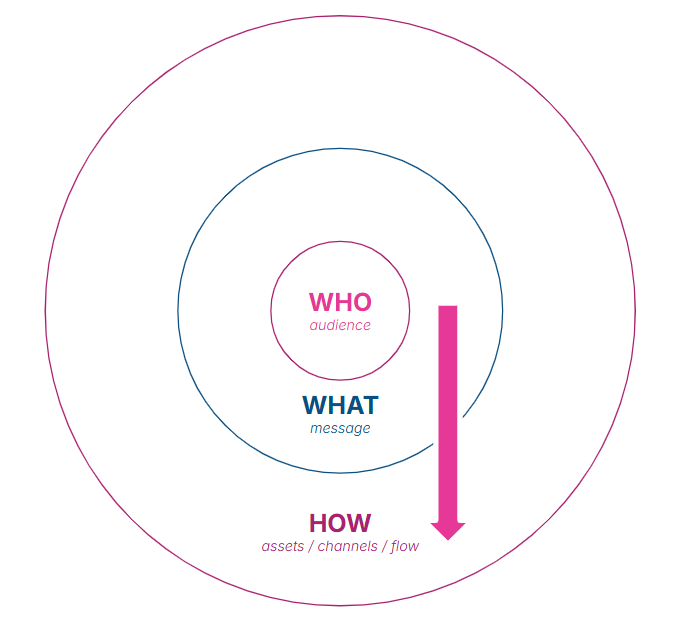
Who — The Audience
At the center of the circle is the audience you just defined.
Everything in the campaign exists to move this person along their journey. The audience is not an abstraction; it is a specific profile with clear needs, beliefs, tensions, and decision context. Every touchpoint, every message, and every channel is calibrated to this person.
What — The Message
The “What” defines the strategic message for that audience.
- It is the idea you want them to understand, remember, and act on.
- It is not a tagline, nor a creative line for social posts: it is the core promise or insight that resonates with the audience’s needs and beliefs.
- Every piece of content or asset must reflect this message in some way. If it doesn’t, it breaks the integration loop.
By locking the message to the audience, you guarantee relevance and clarity.
How — Channels, Assets, and Flows
The “How” describes how the message is delivered: through channels, assets, and the sequence of interactions.
- Channels are not independent levers; each is assigned a role in moving the audience forward.
- Assets are not scattered; they are linked to the message and designed to reinforce each other.
- Flows define the journey: what the audience sees first, next, and last. Timing, repetition, and sequencing all matter.
The How transforms strategy into action. Without this step, even the clearest message fails to reach or influence the audience effectively.
Why the Circle Matters
The Campaign Circle is not just a planning tool: it is a structural rule for integration.
- Start with Who (audience), then define What (message), then How (execution).
- Every channel, every asset, every interaction is evaluated against this loop.
- It ensures cohesion and interdependence, not just visual alignment or simultaneous execution.
When the circle is complete, the campaign becomes a self-contained system: the audience experiences a coherent, logical, and persuasive journey. No touchpoint is isolated. Every element reinforces the next.
The campaign circle provides a way to design integrated campaigns. But design alone is not enough. To avoid falling back into parallel execution, integrated campaigns must meet a set of non-negotiable structural criteria.
What Makes a Campaign Truly Integrated: The Structural Criteria
Not every multi-channel campaign is integrated. To be truly integrated, a campaign must meet a few non-negotiable structural criteria. These are the rules that turn scattered tactics into a coherent system.
- One Campaign, One Audience
- As we’ve emphasized, a campaign must have a single audience at its core.
- If another audience needs to be addressed, it requires a separate campaign (unless it truly shares the same needs, beliefs, and reactions.)
- A Single, Unified Message
- Every touchpoint must reflect the same core idea.
- The message is derived from the audience’s needs and beliefs, not from internal priorities or channel capabilities.
- Purposeful Channel Assignment
- Channels are selected and sequenced based on how they move the audience along the journey.
- Each channel has a specific role and timing; none are there arbitrarily.
- Linked Assets and Touchpoints
- Assets are designed to reinforce one another, creating momentum rather than isolated interactions.
- Each piece is part of the system, not a standalone deliverable.
- Logical Flow Across the Campaign
- There is a deliberate sequence from first exposure to conversion.
- Repetition, timing, and sequencing are planned to maximize understanding and engagement.
- Measurement Aligned to the System
- Success metrics are evaluated at the campaign level, not just by channel or asset.
- This ensures the campaign is judged on the cohesive impact it creates for the audience.
These structural rules ensure that every element of the campaign is interdependent. Integration is not about aesthetic consistency or simultaneous execution: it is about designed interconnection that guides the audience through a coherent experience.
A Simple Example of an Integrated Campaign Built Around One Audience
Imagine a company launching a new project management platform for mid-sized B2B companies, specifically targeting operations managers responsible for coordinating cross-department projects.
Who — The Audience
- Primary audience: operations managers at mid-sized B2B companies
- Needs and beliefs: need to manage projects efficiently, reduce bottlenecks, and improve team collaboration
- Decision context: influenced by software usability, integration with existing tools, and measurable productivity improvements
This audience is the structural anchor of the campaign. Every message, asset, and channel is built for this audience alone.
What — The Message
- Audience Problem: Operations managers struggle to manage projects efficiently because existing software solutions don’t communicate with each other, creating bottlenecks and duplicated work.
- Core Message: “Simplify project management with a platform that integrates seamlessly with your entire tech stack.”
- Proof Point: The platform offers over 5,000 native integrations, allowing teams to connect their existing tools without friction.
Every asset — demo videos, email campaigns, webinars, and case studies — reinforces this message. The problem, solution, and proof point remain consistent across channels, making it crystal clear why this software matters to the audience.
How — Channels, Assets, and Flow
The campaign is designed as a connected system, with each channel feeding into the next to guide the audience toward conversion:
- Interest: LinkedIn ads and sponsored posts drive the audience to webinars or downloadable whitepapers showcasing integration benefits and best practices.
- Consideration:
- Attendees of the webinars enter a nurturing email program with follow-up tips, case studies, and targeted content highlighting integration ease.
- Those who watch a live demo or request a personalized trial roll into a direct outreach program led by account managers, who guide them through evaluation and adoption.
- Conversion: Personalized follow-ups, trial-to-subscription onboarding, and product support ensure the audience completes the purchase decision.
Each step is purposefully sequenced and interdependent. The campaign is not a set of parallel activities — it’s a continuous flow where every touchpoint builds on the previous one, creating a seamless, guided journey from initial interest to conversion.
The Result
- Cohesion is achieved because all elements are built around a single audience and a single, precise message.
- Assets and channels are linked, not isolated — the audience moves through a clear, structured journey.
- The campaign demonstrates that integration is structural, deliberate, and audience-centered, not a patchwork of disconnected activities.
Integrated vs Multichannel vs Omnichannel
It’s common for terms like “multichannel” or “omnichannel” to be confused with “integrated,” but they are not the same. Understanding the differences is critical for designing campaigns that actually work.
- Multichannel: Using multiple channels independently to reach the audience. Each channel may have its own goals, assets, and metrics. Channels coexist, but there is no structural connection.
- Omnichannel: Creating a seamless experience for the audience across channels. The focus is on experience consistency, often driven by technology and CRM systems.
- Integrated: The highest level of cohesion, the campaign is designed as a system:
- One clearly defined audience
- One core message
- Channels, assets, and flows intentionally orchestrated to work together
- Interdependence and structure are baked in from the start
In short: multichannel and omnichannel focus on presence and consistency, while integration focuses on structure and strategic interconnection. Only integrated campaigns ensure that every element advances the same audience along the same journey.
Once these distinctions are clear, the value of true integration becomes obvious.
Conclusion: Why Integrated Campaigns Are a Game-Changer
The biggest reason to design truly integrated campaigns? Better results (including improved ROI, higher conversion rates, and stronger customer engagement) are the clearest indicators that a campaign is truly integrated.
When a campaign is built around a single audience, a single core message, and deliberately orchestrated channels and assets, it doesn’t just look neat: it performs better: higher conversions, more engagement, and stronger ROI.
Other benefits follow naturally:
- No attribution headaches: Every touchpoint contributes to a clear, trackable journey. No more guessing which channel drove the conversion.
- Better customer experience: Audiences move through a coherent, logical journey. Every interaction reinforces the message, creating clarity and trust.
- No leakage of leads: Prospects are guided deliberately from one step to the next. Opportunities are captured, not lost between channels.
- Easier to manage and optimize: With a single audience and a single core message at the center, decision-making is simpler, flows are predictable, and performance can be improved continuously.
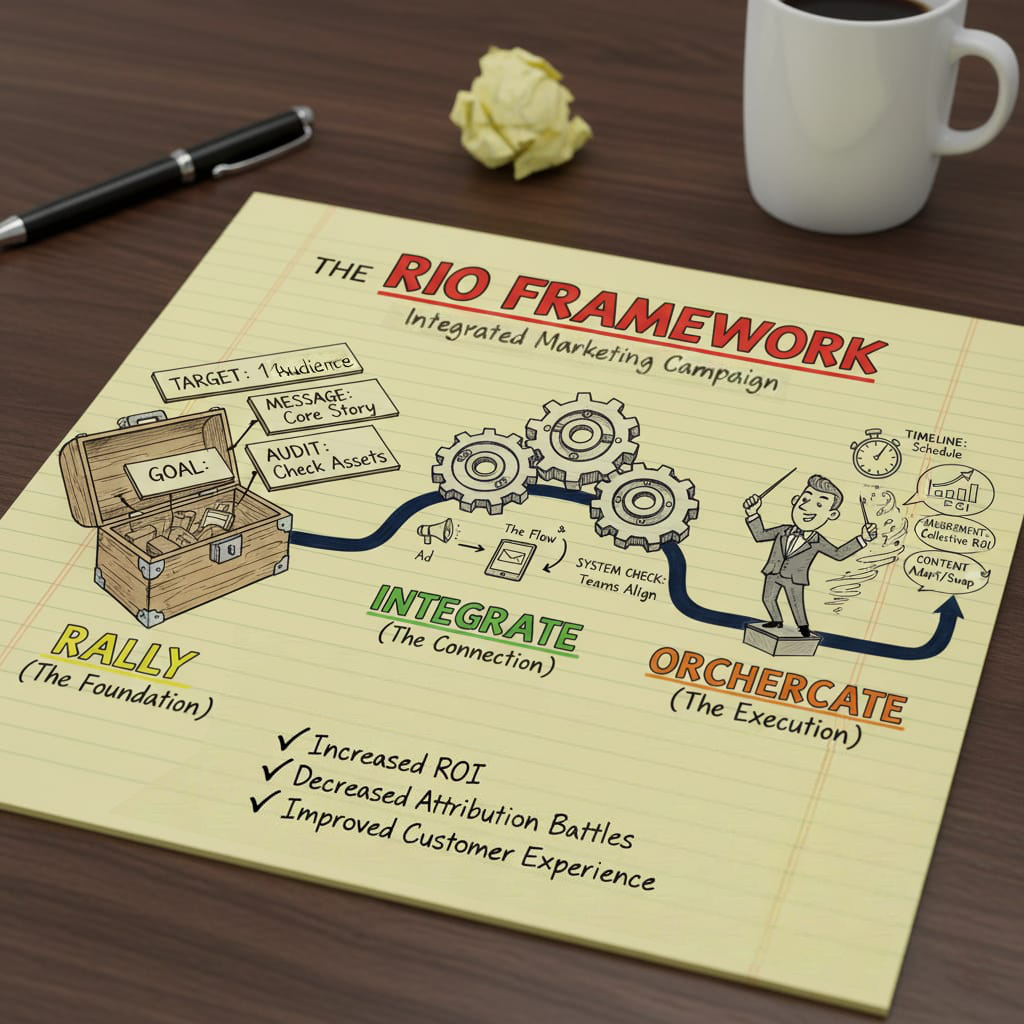
At the heart of this approach is structure: one audience, one message, and a system where channels, assets, and flows work together. This is precisely what the RIO Integrated Marketing Campaign Framework helps marketers do. Without going into all the details, it provides a step-by-step methodology to build campaigns that are fully integrated, efficient, and high-impact.
For anyone tired of fragmented campaigns and seeking real marketing results, the RIO Integrated Campaign Framework is worth exploring.
FAQ
- What is the difference between an integrated campaign and a multichannel campaign?
-
A multichannel campaign uses several channels at the same time, but each channel often operates independently, with its own objectives, assets, and success metrics. An integrated campaign is fundamentally different: it is designed as a single system. All channels are built around one audience, one core message, and a shared campaign goal, with deliberate connections between touchpoints. Integration is not about channel quantity; it is about structural coherence and orchestration.
- Can an integrated campaign target multiple audiences?
-
No. A truly integrated campaign is built around one clearly defined primary audience that shares the same needs, beliefs, and decision context. When a campaign attempts to address multiple audiences at once, message clarity breaks down and orchestration becomes impossible. If another audience requires a different message or responds to different motivations, it should be handled through a separate campaign. One campaign, one audience is a foundational rule of integration.
- How is an integrated campaign different from an omnichannel campaign?
-
An omnichannel campaign focuses on delivering a consistent and seamless experience across touchpoints. While this improves customer experience, it does not automatically make a campaign integrated. An integrated campaign is designed structurally: channels, assets, and actions are intentionally sequenced and connected around a single audience and message. Omnichannel consistency can be part of an integrated campaign, but integration is about how the system is built, not just how it feels.
- Does an integrated campaign require all channels to run at the same time?
-
No. Integration is not about running every channel simultaneously; it is about orchestration. Different channels can activate at different moments, each playing a specific role in moving the audience forward. What matters is that channels are connected through clear transitions and logic, such as a webinar leading into a nurturing program or a demo triggering a targeted outreach sequence. Timing serves the strategy, not the other way around.
- What does “integrated campaign” actually mean in marketing?
-
In marketing, an integrated campaign means a coordinated effort where all channels, assets, and actions are designed as one unified system to influence a specific audience. Instead of isolated tactics running in parallel, every touchpoint reinforces the same core message and contributes to the same objective. Integration ensures clarity, continuity, and measurable progress across the entire campaign journey.
- How do you plan an integrated marketing campaign?
-
Planning an integrated campaign starts with structure, not channels. It begins by defining a clear campaign objective, selecting one primary audience, and articulating a core message that addresses that audience’s needs. Only then are channels and assets selected, based on the role they play in moving the audience forward. Planning focuses on how touchpoints connect and reinforce each other, rather than planning each channel in isolation.
- What is a fully integrated campaign?
-
A fully integrated campaign is one where all elements are aligned and connected: a single audience, a unified message, clearly defined channel roles, and intentional transitions between touchpoints. Data, actions, and outcomes flow through the same system, with no disconnected execution. The campaign operates as a cohesive whole rather than a collection of parallel initiatives.
- What is an integrated campaign strategy?
-
An integrated campaign strategy defines how a campaign will be structured to achieve its objective through coordinated action. It clarifies who the campaign is for, what message will anchor it, and how channels and assets will be orchestrated to guide the audience through a coherent journey. Rather than focusing on individual tactics, the strategy focuses on building a system that drives results as a whole.


 Entrepreneur, international CMO, and Certified Customer Experience Professional (CCXP), I have spent the last 16 years driving growth and high-level marketing strategy across Europe and Asia.
Throughout my career, I have managed global teams to build brands and generate demand, while also founding myfairtool, authoring two industry books, hosting marketing podcasts, and developing the RIO Integrated Marketing Campaign Framework.
In this blog, I share my frameworks, insights, and experience. Please feel free to reach out if you have specific projects for which you would need my expertise.
Julien Rio.











 Français
 English