
The RIO Framework: Finally, a Structure for Integrated Marketing Campaigns That Works
You're running an "integrated" campaign, aren't you? Let's be honest: your 'integration' is probably just four different teams doing four different things at the same time and calling it alignment. Your customers see the chaos. Your budget certainly feels it. You’ve got channels cannibalizing each other, assets gathering digital dust, and an attribution model that looks like modern art: meaningless, confusing, and expensive. I know it, because I've been there, countless times.
The problem isn't your talent; it's your architecture. You're trying to boil the ocean with good intentions when you need a blueprint. You need structure grounded in reality, not another airy manifesto. The RIO Integrated Marketing Campaign Framework template is that blueprint. It's the operational guide designed to finally turn your marketing noise into a single, measurable system.
The Blunt Truth: Why Your Campaigns Are Leaky Sieves
Let’s cut the fluff. You’re stressed, your teams are exhausted, and your budget is disappearing faster than a free lunch in the office kitchen. Why? Because you’re trying to run an integrated campaign with a stack of disconnected tools and a team structure that looks less like a collaborative system and more like a collection of walled-off kingdoms.
You've got your social media guru, your email champion, your web master, and your event planner. Each one is a genius in their silo, but when you put their efforts together, it doesn't form a campaign; it forms a mess.
This is the reality of fragmentation. We pay lip service to the concept of the customer journey, but we design our marketing efforts like a game of whack-a-mole: a campaign pops up here, a white paper there, a webinar floats off into the ether. Every piece is an island, and the customer is expected to swim the chaotic distance between them. It’s no wonder they drown in confusion and your leads fall out of the funnel like pennies from a torn pocket.
You need to stop asking how you can do more marketing and start asking how you can make your existing marketing work together. The answer isn't a new SaaS platform or a motivational offsite; it's a structural blueprint.
I know this frustration intimately. I’ve spent years running the same fragmented, leaky campaigns, watching budgets vanish and teams burn out. I've been the one stuck juggling those fifty independent tasks and feeling the acute pain of misalignment. But after years of working, testing, and fine-tuning an operational model in the trenches, and then months turning that model into an applicable, repeatable framework, I am proud to introduce the RIO Integrated Marketing Campaign Framework. This is the structure I wish I had 15 years ago.
This Is Not Your Grandma's Strategy
If you’re looking for another conceptual diagram filled with circles and arrows that vaguely describe how people buy things, you’re in the wrong place. The RIO Integrated Marketing Campaign Framework is different because it isn't theory; it is an operational system that I have implemented across multiple regions, diverse teams, and countless campaign managers. This is the culmination of a decade spent moving past "best practices" and focusing on what actually works when the pressure is on.
Where Traditional Models Fall Short: Looking Past the Simple Sales Funnel
Traditional marketing frameworks (the ones you drew on a whiteboard back in college) are fantastic for conceptual understanding. They teach us the basic rhythm of consumption. But they stop dead at the moment you actually have to do the work. They offer zero guidance on how to get your own people aligned and your assets connected before you even spend your first dollar.
The true power of the RIO Integrated Marketing Campaign Framework lies in its focus on preparation and operationalizing the journey. It understands that you can’t achieve external coherence (a smooth customer experience) without internal structure (a functioning team and system).
If you don't define who owns the follow-up, if you don't connect the webinar registration to the nurturing email flow, and if you don't agree on one primary message, you haven't integrated anything. You've just scheduled simultaneous events.
The RIO Difference: Internal Alignment Comes First
The RIO approach forces you to stop thinking about individual tactics and start viewing your campaign as a single, interdependent ecosystem. If your Facebook ad is designed to drive registration for an event, that ad must be structurally and measurably linked to the event, which in turn must be linked to the sales follow-up. This isn't theory; it's a system of inputs and outputs designed to reduce friction and maximize flow.
And a quick, unsugarcoated note on attribution: RIO is grounded in a multi-touch attribution philosophy. It saves you the headache of sterile, pointless debates over whether the first click or the last conversion gets the credit. In an integrated system, every touchpoint (from the "soft" brand influence to the hard conversion) plays a role. The framework lets your channel managers measure their own metrics while the campaign manager tracks the only number that truly matters: the collective ROI of the entire RIO-driven system.
Introducing the RIO Integrated Marketing Campaign Framework and the Downloadable Playbook Template
The methodology is structured into three clear, operational phases: Rally, Integrate, and Orchestrate (R.I.O). This is a non-negotiable, chronological sequence for turning chaos into order.
To make this framework instantly actionable (because we don't need more theory, we need execution) I built a downloadable playbook template. This is the practical tool, the blueprint, that walks you step-by-step through the RIO phases, ensuring you don't miss a critical link or communication step. You get the structure and the tool to implement it immediately.
The Three Acts of Sanity: Inside the RIO Integrated Campaign Framework
The entire methodology is structured into three clear phases: Rally, Integrate, and Orchestrate. It's the necessary, sequential backbone that ensures you move from good intentions to measurable results.
Phase 1: Rally (Getting Your Ducks in a Row)
This is the step where you gather everything before you lift a finger to execute. You wouldn't try to build a house without knowing where the walls go, yet most marketers launch campaigns before they've truly rallied their core components.
The Rally phase is about achieving absolute clarity on:
- The Single Target: Defining the unified audience and persona. Stop trying to talk to everyone; it's just expensive silence.
- The Unified Message: Crystallizing the one core, repeatable message that every channel must adhere to. This kills the dissonance where your email says one thing and your social ad says another.
- The Quantifiable Goal: Setting measurable outcomes for the entire campaign, not just for individual channel managers.
- Resource and Asset Audit: Identifying every piece you need (from the landing page to the social image) and confirming its existence and availability.
Rallying means ensuring your team and your resources are marching to the exact same beat. The RIO Integrated Marketing Campaign Framework template is critical here because it ensures you aren't stuck two weeks into a campaign realizing you forgot to brief the sales team on the new talk track or that the required video is still in draft form.
Phase 2: Integrate (Building the Flow, Not the Dead End)
Integration is where strategy becomes a system, not a suggestion. This is where the majority of campaigns fail because they focus on delivery instead of connection.
Integration means mapping out the journey. What happens after a person clicks the banner? What is the logical next step in their journey? If they download the e-book, do they immediately get hammered by a sales rep, or do they enter a nurturing flow designed to warm them up first?
This phase is about connecting the dots to eliminate "leaky funnels." I define sequences: activity A flows into activity B, which leads to activity C. Messaging is unified. Assets are modular and reusable. The RIO Integrated Campaign Framework template ensures you have a coherent, logical path for every target persona, ensuring zero dead ends in your customer journey. The template helps visualize this flow so every team understands not just their part, but their part in the whole.
Phase 3: Orchestrate (Making the Machine Run)
Only once you have rallied your resources and integrated your flows do you move to execution. This is the Orchestrate phase.
If Phases 1 and 2 were the engineering work, Phase 3 is the activation. This is where sequencing happens: which channel fires first, and when does the follow-up kick in? Execution is tracked meticulously, not just by channel, but by how the entire campaign performs against its unified goal.
Orchestration is also where your RIO Integrated Marketing Campaign Framework template (your downloadable playbook) becomes a living dashboard. It allows you to monitor spend velocity and performance against your forecasted outcomes. If a channel is drastically underperforming its required volume, you have the structural data to justify a change, not just a gut feeling. It puts the control back into your hands, turning you into a conductor instead of a firefighter constantly reacting to localized chaos.
The Bottom Line: How the RIO Template Delivers Real ROI
The RIO Integrated Marketing Campaign Framework doesn't just promise efficiency; it mandates it. It stops your team from operating based on hope and starts grounding them in a measurable, repeatable system.
Kill the Asset Graveyard: Reduced Waste, Higher Impact
How many assets (case studies, infographics, videos) have been created in your organization that were barely promoted or were launched at the wrong time with the wrong message? Too many. This is where creative work goes to die, and it's an expensive funeral.
The RIO framework forces alignment and a utility check: if an asset doesn't fit into the integrated flow defined in Phase 2, it doesn't get created. Period. You save time, money, and the demoralizing effort of building things nobody uses. By maximizing the utility of every piece of content, the RIO Integrated Marketing Campaign Framework ensures your creative team is focused on high-impact production, not low-value busywork.
Clarity Over Chaos: Easier Management and Clearer ROI Attribution
When all campaign activities are funneled through the same coherent architecture, management instantly becomes simpler. Instead of juggling fifty independent tasks, you manage three to five integrated campaigns.
The data is centralized, decision-making is easier, and you can finally link your spend directly to business outcomes. When you are asked, "What did we get for that budget?" you won't have to shrug and say, "Brand awareness." You'll have hard, measurable results derived from a structurally sound RIO Integrated Marketing Campaign Framework. This framework is the accountability mechanism that has been missing from your process.
A Customer Journey That Doesn't Feel Like a Hostage Situation
Most importantly, the framework is a kindness to your customer. They stop seeing random messages from your brand at random times. They experience continuity. The messaging is consistent, the visuals don't change identity every week, and the progression from one touchpoint to the next feels natural.
This consistency builds trust, and trust is the only thing that turns fragmented attention into long-term loyalty. When a customer moves seamlessly from a social ad to a landing page, then to a relevant email, and finally to a sales conversation that is already informed by their past behavior (this is what Integration achieves), they stop seeing you as a chaotic brand and start seeing you as a reliable partner.
Stop Planning, Start Building
You've spent enough time in the theoretical weeds. Integrated marketing is a necessity, but without a practical blueprint, it will remain an expensive myth.
I created the RIO Integrated Marketing Campaign Framework to solve a very specific problem: the chasm between having a great strategy and having a functioning, measurable campaign. It's the operating system you need to achieve predictability, measurability, and coherence in a world of complexity. It is the real-world, battle-tested structure that makes integrated campaigns actually doable.
Now, let's talk about the future, because I know exactly where your head is at. You're thinking about how your teams can leverage AI tools (ChatGPT, Gemini, Perplexity, DeepSeek, Le Chat, and the others) to speed things up. Brilliant idea. The framework is designed for efficiency, and I've ensured it works seamlessly with the latest technology.
Crucially, the framework comes pre-loaded with a constructed prompt. You can take this prompt, feed it to your favorite LLM, and instantly get your AI Assistant to guide you through the initial steps of campaign construction based on the RIO methodology. This isn't just a framework; it's a future-proof tool designed to reduce friction between human strategy and AI execution.
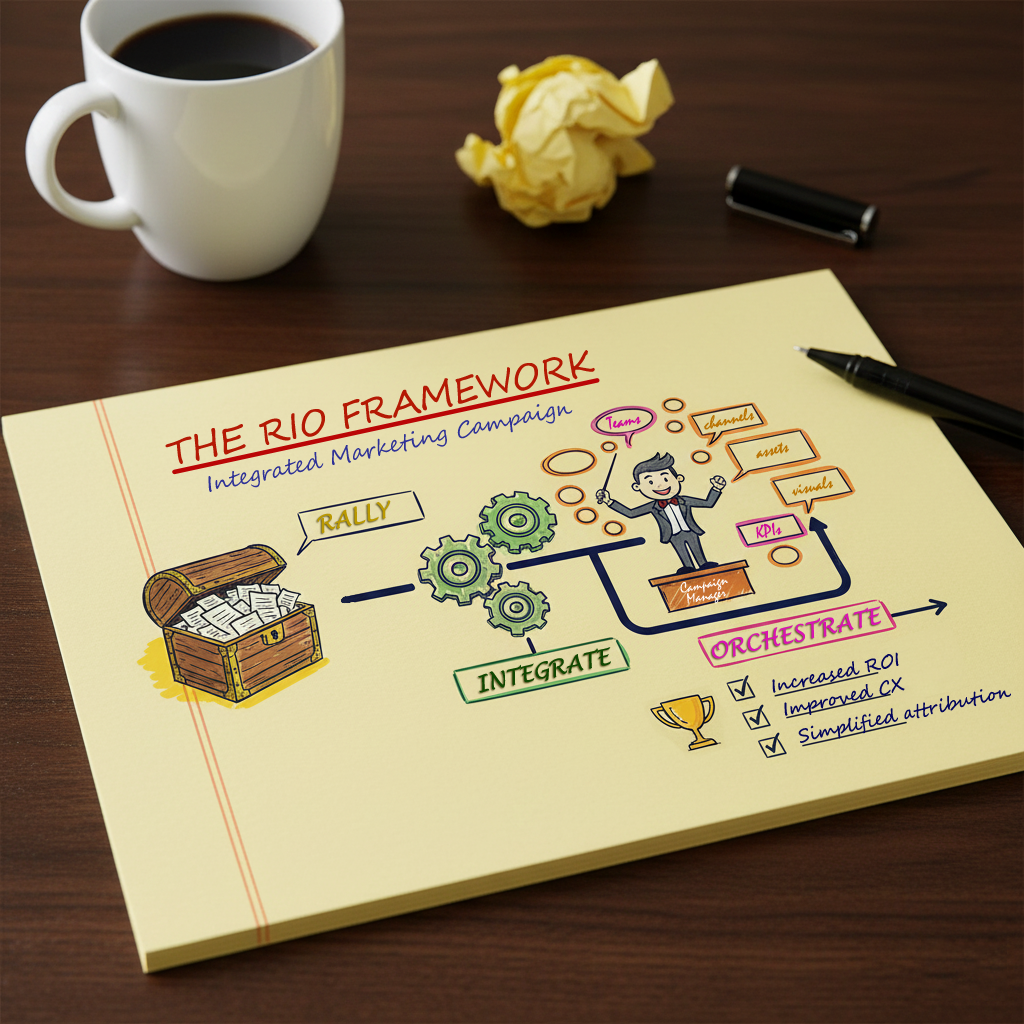
Stop accepting chaos. Stop settling for fragmented results. If you want a system that works (one that aligns your teams, protects your budget, and delivers predictable ROI) you need to download the accompanying RIO Integrated Marketing Campaign Framework template today. It's time to stop planning and start building.
Last update: 2025-12-01 Tags: Marketing campaign integrated marketing campaign integrated campaign RIO framework


 Entrepreneur, international CMO, and Certified Customer Experience Professional (CCXP), I have spent the last 16 years driving growth and high-level marketing strategy across Europe and Asia.
Throughout my career, I have managed global teams to build brands and generate demand, while also founding myfairtool, authoring two industry books, hosting marketing podcasts, and developing the RIO Integrated Marketing Campaign Framework.
In this blog, I share my frameworks, insights, and experience. Please feel free to reach out if you have specific projects for which you would need my expertise.
Julien Rio.











 Français
 English