
Stop Reacting: How to Handle Urgent Announcements Without Chaos
If you’re drowning in “urgent” press releases, unplanned promotions, or CEO-driven thought leadership that forces you to scrap your campaigns (only to end up with disjointed, low-impact noise) this is your fix. Here’s how to turn chaos into structure, without sacrificing agility.
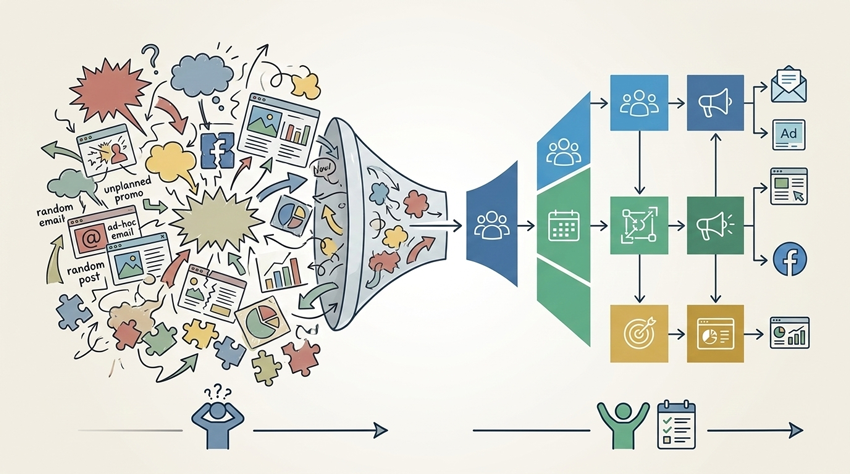
The Reality of Marketing Life
As a marketing leader, you know that marketing life is nothing like a straight road. If anything, there are bumps on the road, hills to climb, chasms to jump, obstacles to avoid.
And even when you have a very clear editorial calendar for the next 12 months, there are all these things you didn’t see coming:
A new feature you urgently need to announce because your product team never gave you the heads up that it was coming.
A new press release to cover an acquisition or merger that the market needs to know about, and you were not privileged enough to have that information.
This new Black Friday, back-to-school, Xmas, or Easter promotion that you urgently need to advertise because we’re not hitting our numbers this quarter and we badly need it.
This thought leadership piece that your CEO decided to write overnight without involving you and that now deserves all your attention.
This new product launch that we had scheduled to launch next year, but guess what? Competitors have launched their version last week, and it can’t wait anymore. It’s urgent that you announce it.
Marketing life is made of that: a clear strategy that you can never execute on because you need to amend it every other day. And it wouldn’t necessarily be a problem if you had a structure in place to handle it right.
But the sad truth is that most of the time, you don’t have sufficient time to plan it efficiently. So that press release is going to be just that: a press release, a one-off that you send to journalists and hope that they will pick it up. This promotion for which you have very high expectations, you’re just going to post it on LinkedIn and Facebook, change the hero banner on your website.
This new feature announcement that you have, you’re going to urgently build an email about it and send it to your entire database without really taking the time to think about whether that’s going to be considered as spam because your database is already receiving another two emails this week on completely different topics that have nothing to do with it.
Ultimately, you get shit done. But there is no structure. There is no strategy. It’s just an immediate answer to an urgent stimulation.
The Root Causes: Why This Happens
So how could you do this differently? Let’s take one step back and see why this problem occurs. There are two things.
First, there are urgent changes of direction, urgent communications, urgent ideas. And in a perfect world, you would change things in a way that there is no urge or emergency anymore. But we don’t live in a perfect world. And whatever you do, there’s always going to be that last-minute change that no one saw coming.
So let’s look at the other cause: your marketing is just a patchwork of activities that accumulate. You have a webinar here, a Google ad there, some random visuals on LinkedIn, an event next week, and 52 variations of email nurturing campaigns that are being delivered to your database. All of that is managed by different people in different teams with different goals and very little linking them together.
So when that new communication or that urgent announcement comes into play, it’s just yet another one-off activity that’s just going to come on top of all the rest. That’s just going to take your attention away from maintaining all the other pieces of your machine that already are not very well glued together, and trying to hold the whole thing so the castle doesn’t collapse.
The Solution: Integrated Marketing Campaigns
But what if you weren’t looking at siloed activities but a well-oiled machine called integrated marketing campaigns?
An integrated marketing campaign is a campaign structured around a specific audience that properly integrates all your channels with a logical flow and clear messaging tailored to that audience.
Let’s say you have awareness channels that immediately direct people to consideration content on the right platforms. You slowly nurture them with educational content and push them down the funnel to convert.
Now, instead of managing 50 different random activities, you’re running 30 well-linked activities designed with the customer journey in mind. You could map it out visually and follow the path your customers take from the top of the funnel to the bottom.
Everything makes sense. That’s what an integrated campaign looks like.
How Integrated Campaigns Change the Game
When you have clear, audience-centric campaigns running, the game changes. You have one campaign for Audience A, one for Audience B, one for Audience C. Since you don’t want to spam your audiences, maybe in Q1 you focus on topic 1, and in Q2 you focus on topic 2, always asking, "What message resonates with my audience?" rather than "What product do I want to sell?"
Now, your editorial calendar is clear. Your channels are set up, running, and efficient. You’ve decided that throughout Q1, you’ll have a set of assets, visuals, and content focused on that quarter’s theme. In Q2, you don’t destroy the campaign and start from zero. The campaign keeps running, but you swap out some visuals, update some assets, and refresh the content to align with the new message.
This transition is seamless, so your customers don’t feel lost when switching from one message to another. Since all your channels are connected and delivering variations of the same message, the shift feels natural.

Handling Urgent Announcements the Right Way
Now, what happens when you have an urgent message, announcement, or change in strategy? Maybe it's an urgent promotion, an M&A to announce, a new product, a new feature, or that you want to advertise the new Gartner Magic Quadrant or your position in the latest Forrester Wave.
Instead of launching another one-off, you sit down and look at your campaigns. You leverage the existing foundation. The first thing you do is figure out: Which audience or audiences will this message resonate with? Does it resonate with everyone? Usually not, but there might be exceptions. Or does it resonate with a specific audience or set of audiences?
Once you know that, you can pinpoint the campaigns that are relevant, look at their editorial calendars, and say: I’m not going to create another email for this. I’m not going to launch another LinkedIn post. I’m not going to send another newsletter. Instead, you leverage the existing campaign and refresh the editorial calendar one more time than you originally planned.
This approach has multiple benefits:
- It’s much easier. You don’t need to build anything new. You write the message, but instead of creating new emails, LinkedIn campaigns, or Facebook posts, you use the channels already running.
- You’re not wasting money. You’re not competing with yourself by sending multiple messages to the same audience or bidding against your own campaigns on platforms like LinkedIn.
- Transitions are smoother. Since you’re working within an existing campaign, you can make the shift feel natural: using similar visuals, vocabulary, and messaging so it doesn’t jar your audience.
- You save effort. Once the announcement is no longer relevant, you can easily switch back to the original content without starting from scratch.
- You track results easily. When you launch a random communication, you don’t have time to set up proper tracking, it’s just extra work for something running for a few days. But when your campaign is already running, you’re just updating the message. You can see whether this specific announcement drives more engagement or results than your usual content.
The Bottom Line
The next time you have an urgent promotion, an M&A announcement, a new product launch, or a new feature to advertise, don’t build everything from scratch. Make sure you already have a robust integrated marketing campaign running, and leverage it.
The time you’ll save and the results you’ll get are worth the initial investment.
If you want to get serious about integrated marketing campaigns, check out the RIO Integrated Campaign Framework: a free public resource with the tools, templates, and knowledge you need to structure your campaigns efficiently from day one.
FAQ
- How do I handle last-minute marketing announcements without disrupting my strategy?
-
Instead of treating every last-minute request like a new project that needs its own set of assets, you should look at the integrated campaigns you already have running. Identify which audience the announcement actually matters to, and then swap out or update the existing content in those specific campaigns. This lets you deliver the news without trashing your current schedule or confusing your team.
- How can I stop my marketing team from constantly firefighting urgent requests?
-
Firefighting usually happens because marketing activities are siloed and messy. If you shift to a framework to structure your campaigns, your team isn't managing 50 random tasks anymore; they’re managing a few well-oiled machines. When something "urgent" pops up, they don't panic: they just plug the new info into the existing channels and workflows, which keeps the stress levels way down.
- How can I integrate urgent announcements into my existing campaigns seamlessly?
-
The trick is to use the same visuals, tone, and customer journey that’s already in place. Since your campaign is already targeting a specific audience, you just refresh the editorial calendar within that campaign. It feels like a natural update to the conversation you’re already having with your customers, rather than a random, jarring interruption.
- Why does my marketing team always feel like they’re just reacting to emergencies?
-
It’s mostly because many teams work in a patchwork of one-off activities: a random webinar here, a LinkedIn post there. Without a solid structure, every new request feels like a brand-new mountain to climb. When you don't have a foundation to lean on, you’re forced to start from scratch every time the CEO has a "great new idea," which makes everything feel like an emergency.
- What is an integrated marketing campaign, and how does it fix chaotic marketing?
-
It’s basically a campaign designed for a specific audience where all your channels (email, ads, social) are linked with a logical flow. It fixes the chaos because it gives you a "home" for your content. Instead of launching random stuff, you’re just updating a structured system. It’s like having a shelf for your tools instead of throwing them all in a pile on the floor.
- How do I avoid overwhelming my audience with too many urgent updates?
-
Stop sending "extra" emails or posts on top of what’s already planned. When you use a framework to structure my campaigns, you replace current content with the urgent update instead of just piling it on. This way, your audience still gets the same volume of messages, but the content is updated to reflect what’s actually important right now.
- How can I announce a product launch or promotion using my existing marketing activities?
-
Look at your active campaigns and figure out which one targets the right people for this launch. Instead of building a whole new "launch plan," you just pivot the messaging of that existing campaign. Use the channels that are already performing—like your automated email tracks or social schedules—and swap in the new product news. It’s faster and way more effective.
- How do I track the success of last-minute marketing campaigns without wasting time?
-
Setting up tracking for a one-off announcement is a pain and usually gets skipped. But if you're plugging the announcement into a campaign that’s already running, the tracking is already there. You can just look at your existing dashboard to see if the new message is getting more clicks or conversions than the content you were running the week before.


Throughout my career, I have managed global teams to build brands and generate demand, while also founding myfairtool, authoring two industry books, hosting marketing podcasts, and developing the RIO Integrated Marketing Campaign Framework.
In this blog, I share my frameworks, insights, and experience. Please feel free to reach out if you have specific projects for which you would need my expertise.
Julien Rio.












 Français
 English